← Back to Course
Pumps and Solenoid Valves
🔄 Pumps and Solenoid Valves Selection Guide - Choose the Right Hardware
🔄 What You'll Learn:
- 💧 Select the right pump for your farm (submersible, centrifugal, diaphragm, solar)
- 🔌 Understand solenoid valve types (24V AC vs 12V DC) and wiring
- ⚡ Calculate required flow rate and head pressure for your irrigation system
- 💰 Compare costs and choose the best value for your budget
Choosing the right pump and solenoid valves is critical for a reliable irrigation system. The wrong pump won't provide enough pressure or flow. The wrong valves won't open reliably. This guide helps you select the correct components for your farm's needs.
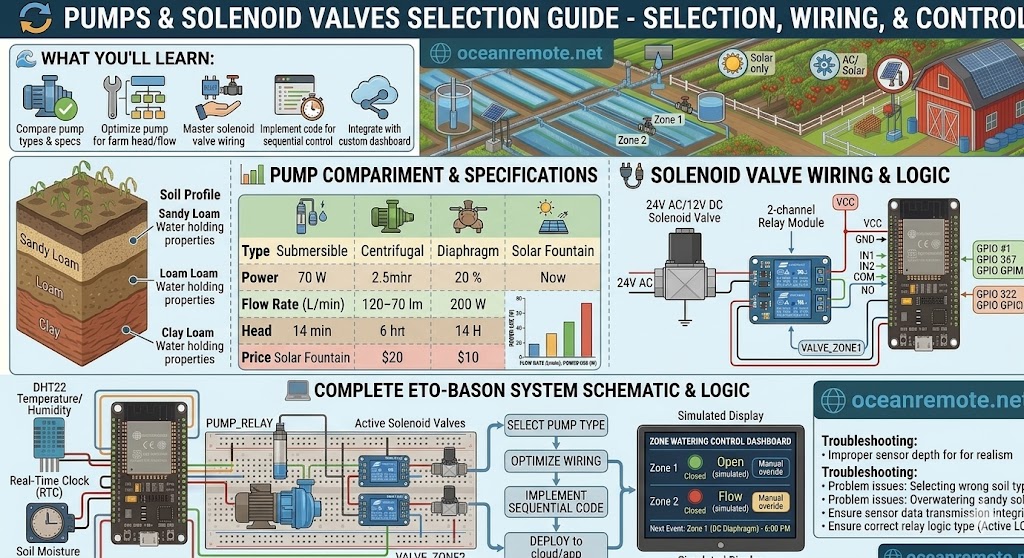
📊 Pump Comparison Guide
| Type | Power Source | Flow Rate (L/min) | Head (max height) | Best For | Price Range |
|---|---|---|---|---|---|
| 💧 Submersible | AC 220V or DC 48V | 10-200 L/min | 20-100m | Boreholes, deep wells, large farms | $100-500 |
| 🔄 Centrifugal | AC 220V or Solar | 20-500 L/min | 10-50m | Surface water (rivers, ponds, tanks) | $50-200 |
| ⚙️ Diaphragm | 12V DC or 24V DC | 5-30 L/min | 20-60m | Drip irrigation, small farms, battery/solar | $30-80 |
| ☀️ Solar Fountain | Solar only (12V-24V) | 2-10 L/min | 5-15m | Small gardens, off-grid, no battery | $20-40 |
| 🚰 Booster Pump | AC 220V | 15-60 L/min | 20-40m | Increasing pressure from existing supply | $60-150 |
💡 How to Calculate Pump Size for Your Farm:
- Flow rate needed: Number of drip emitters × 2 L/hour (typical). For 1,000 emitters = 2,000 L/hour = 33 L/min.
- Head pressure needed: Vertical height (m) + friction loss + operating pressure (20-30m for drip).
- Rule of thumb: 1 hectare of drip irrigation needs 30-50 L/min at 20-30m head.
- Add 20% margin: Always oversize pump slightly for future expansion.
🔌 Solenoid Valve Selection
| Type | Voltage | Power | Best For | Price |
|---|---|---|---|---|
| Latching Solenoid | 9-12V DC pulse | 0.5W (only during switching) | Battery/solar systems (ultra-low power) | $15-30 |
| Standard Solenoid | 12V DC or 24V AC | 2-5W (continuous) | AC-powered systems, mains electricity | $10-20 |
| Motorized Ball Valve | 12V DC or 24V AC | 3-10W | Large pipes, high flow rates, dirty water | $30-60 |
💡 Latching vs Standard Solenoid Valves:
- Latching (Pulse) Valves: Use power only to OPEN or CLOSE (0.5W). Stay in position without power. Perfect for battery/solar systems.
- Standard Valves: Need continuous power to stay OPEN (2-5W). Require AC power or large battery. Cheaper but use more energy.
- Recommendation: For remote/solar farms, spend extra on latching valves.
🔌 Solenoid Valve Wiring Diagram
═══════════════════════════════════════════════════════════════════════════════
                    SOLENOID VALVE WIRING (12V DC)
═══════════════════════════════════════════════════════════════════════════════

    Solenoid Valve (12V DC)          Relay Module (4-channel)         ESP32
    ══════════════════════           ════════════════════════         ════════

    Wire 1 (Common)     ──────────►  COM (Common)
    Wire 2 (Open/Close) ──────────►  NO (Normally Open)
                                   (NO connects to COM when relay ON)

    Valve Power (+)     ◄──────────   External 12V Power Supply (+)
    Valve GND (-)       ──────────►   External 12V Power Supply (-)
                                   ──────────────────────────►  GND (shared)

    Relay VCC (5V)      ──────────►  5V (ESP32 VIN or external)
    Relay GND           ──────────►  GND
    Relay IN1           ──────────►  GPIO5
    Relay IN2           ──────────►  GPIO18
    Relay IN3           ──────────►  GPIO19
    Relay IN4           ──────────►  GPIO21

═══════════════════════════════════════════════════════════════════════════════

    ⚠️ IMPORTANT:
    - Solenoid valves need their OWN power supply (12V or 24V)
    - NEVER power valves from ESP32 (will destroy ESP32!)
    - Share GND between valve supply, relay, and ESP32
    - For AC valves, use separate AC power and FATAL if miswired

═══════════════════════════════════════════════════════════════════════════════
📖 Complete Pump and Valve Control Code
/*
 * Complete Pump and Solenoid Valve Control
 * Multi-zone irrigation with master pump relay
 */

#include <Arduino.h>

// ========== PIN DEFINITIONS ==========
#define PUMP_RELAY 4        // Main water pump (active LOW)
#define VALVE_ZONE1 5       // Zone 1 solenoid valve
#define VALVE_ZONE2 18      // Zone 2 solenoid valve
#define VALVE_ZONE3 19      // Zone 3 solenoid valve
#define VALVE_ZONE4 21      // Zone 4 solenoid valve

// ========== ZONE CONFIGURATION ==========
struct Zone {
    int valvePin;
    const char* name;
    int durationSeconds;
};

Zone zones[] = {
    {VALVE_ZONE1, "Tomatoes", 300},
    {VALVE_ZONE2, "Peppers", 300},
    {VALVE_ZONE3, "Cucumbers", 240},
    {VALVE_ZONE4, "Nursery", 180}
};

const int ZONE_COUNT = 4;

// ========== WATER A SINGLE ZONE ==========
void waterZone(int zoneIndex) {
    if (zoneIndex < 0 || zoneIndex >= ZONE_COUNT) return;

    Zone &z = zones[zoneIndex];

    // Step 1: Turn on pump
    digitalWrite(PUMP_RELAY, LOW);
    Serial.println("🟢 Main pump ON");
    delay(2000);  // Allow pressure to build

    // Step 2: Open zone valve
    digitalWrite(z.valvePin, LOW);  // Active LOW - valve opens
    Serial.printf("💧 Zone %d (%s): Watering for %d seconds\n",
                  zoneIndex+1, z.name, z.durationSeconds);

    // Step 3: Water for duration
    delay(z.durationSeconds * 1000);

    // Step 4: Close zone valve
    digitalWrite(z.valvePin, HIGH);
    Serial.printf("✅ Zone %d (%s): Complete\n", zoneIndex+1, z.name);

    // Step 5: Turn off pump
    digitalWrite(PUMP_RELAY, HIGH);
    Serial.println("🔴 Main pump OFF");

    delay(2000);  // Pause before next zone
}

// ========== WATER ALL ZONES SEQUENTIALLY ==========
void waterAllZones() {
    Serial.println("\n═══════════════════════════════════════════");
    Serial.println("💧 STARTING SEQUENTIAL IRRIGATION");
    Serial.println("═══════════════════════════════════════════\n");

    for (int i = 0; i < ZONE_COUNT; i++) {
        waterZone(i);
    }

    Serial.println("\n✅ ALL ZONES COMPLETE\n");
}

// ========== EMERGENCY STOP ==========
void emergencyStop() {
    Serial.println("🚨 EMERGENCY STOP - Closing all valves and turning off pump");

    // Close all zone valves
    for (int i = 0; i < ZONE_COUNT; i++) {
        digitalWrite(zones[i].valvePin, HIGH);
    }

    // Turn off pump
    digitalWrite(PUMP_RELAY, HIGH);

    Serial.println("✅ All systems halted");
}

// ========== SETUP ==========
void setup() {
    Serial.begin(115200);

    // Configure pump relay
    pinMode(PUMP_RELAY, OUTPUT);
    digitalWrite(PUMP_RELAY, HIGH);  // Start with pump OFF

    // Configure zone valves
    for (int i = 0; i < ZONE_COUNT; i++) {
        pinMode(zones[i].valvePin, OUTPUT);
        digitalWrite(zones[i].valvePin, HIGH);  // Start with valves CLOSED
    }

    Serial.println("╔═══════════════════════════════════════════╗");
    Serial.println("║    💧 PUMP & VALVE CONTROL SYSTEM        ║");
    Serial.println("╚═══════════════════════════════════════════╝\n");

    Serial.printf("🔢 Zones configured: %d\n", ZONE_COUNT);
    for (int i = 0; i < ZONE_COUNT; i++) {
        Serial.printf("   Zone %d: %s (%d seconds)\n",
                      i+1, zones[i].name, zones[i].durationSeconds);
    }
    Serial.println("");
}

// ========== LOOP ==========
void loop() {
    // Example: Water all zones once per day
    waterAllZones();

    // Wait 24 hours before next cycle (adjust as needed)
    Serial.println("⏰ Waiting 24 hours until next irrigation cycle...\n");
    delay(86400000);  // 24 hours
}
📖 Case Study - Solar-Powered Drip System in Kenya:
A 2-hectare farm needed off-grid irrigation:
- 💧 Solution: 12V DC diaphragm pump (35 L/min) + 12V latching solenoid valves
- ☀️ Power: 300W solar panel + 200Ah battery
- 💰 Cost: $400 for pump + $100 for valves (4 zones)
- 📈 Result: System runs entirely on solar, waters 4 zones daily
"The 12V DC pump and latching valves use so little power. We never worry about electricity." - Farm Owner, Kenya
⚠️ Common Mistakes to Avoid:
- ❌ Powering valves from ESP32: Valves need 12V/24V - will destroy ESP32! Use relay module.
- ❌ Wrong voltage: 12V valves on 24V power = burn out. 24V valves on 12V = won't open.
- ❌ No flyback diode: Solenoid coils create voltage spikes. Add 1N4007 diode across valve terminals.
- ❌ Undersized pump: Pump can't maintain pressure for all zones → uneven watering.
- ❌ AC valves with DC: AC valves won't work on DC power (and vice versa). Check specifications!
🎯 Key Takeaways:
- ✅ Small farms (1-2 ha): Diaphragm pump (12V DC, $30-80) + latching valves
- ✅ Medium farms (2-5 ha): Centrifugal pump ($50-200) + standard valves
- ✅ Large farms (5+ ha): Submersible pump ($100-500) + motorized valves
- ✅ Off-grid/solar: 12V DC diaphragm pump + latching valves (ultra-low power)
- ✅ Always oversize pump by 20% for future expansion and pressure loss
- ✅ Latching valves save power but cost more ($15-30 vs $10-20)
💡 Key Takeaways:
- Apply these concepts directly to your farm or project.
- Take notes on important details for the quiz.
- Use the button below to track your progress.
×
![Enlarged view]()