Smart Water Conservation - Part 1
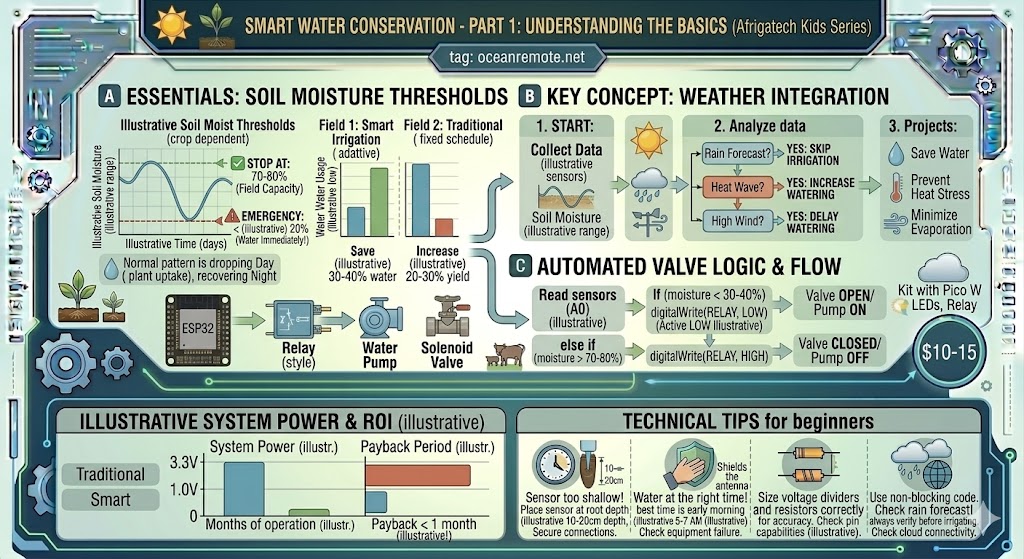
💧 Smart Water Conservation - Part 1: Understanding the Basics
💧 What You'll Learn:
- 💡 Understand what smart irrigation is and how it works
- 📊 Learn soil moisture thresholds for optimal watering
- 🌧️ Integrate weather forecasts to skip unnecessary irrigation
- 💰 Discover 30-40% water savings and 20-30% yield increase
Smart irrigation uses sensors and automation to water crops only when they need it. Unlike traditional irrigation (watering on a fixed schedule), smart irrigation adapts to real-time soil conditions and weather forecasts. The result: less water waste, healthier crops, and higher yields.
Most farmers water on a fixed schedule - every day at 6 AM for 30 minutes. This ignores rain, soil moisture, and weather. Result: 30-50% of water is wasted! Smart irrigation solves this by watering only when the soil actually needs it.
🔧 Key Concepts of Smart Irrigation
📊 1. Soil Moisture Thresholds
- Water when: Soil moisture drops below 30-40% (crop dependent)
- Stop when: Moisture reaches 70-80% (field capacity)
- Emergency: If moisture below 20%, water immediately!
🌧️ 2. Weather Integration
- Skip irrigation: When rain is forecast (save water)
- Increase watering: Before heat waves (prevent stress)
- Delay watering: When high winds predicted (evaporation loss)
⚡ 3. Automated Valves (Relays)
- ESP32 → Relay → Water pump or solenoid valve
- Automatically turns water ON when soil is dry
- Automatically turns water OFF when soil is moist
A 2-hectare vegetable farm switched from timer-based irrigation to smart irrigation with soil moisture sensors:
- 💧 Before: Watered 2 hours daily (14,000 liters/day) regardless of rain
- 💧 After: Only watered when moisture < 35% (avg 8,000 liters/day)
- 💰 Savings: 6,000 liters/day × 30 days = 180,000 liters/month saved
- 📈 Yield: 25% increase from optimal watering
"The smart irrigation system paid for itself in 3 months!" - Farm Owner, Kenya
📊 Benefits of Smart Irrigation
- 💧 Save 30-40% on water bills - Water only when needed, not on a schedule
- 🌱 Healthier crops - No over-watering (root rot) or under-watering (stress)
- ⏰ Save time - No manual watering; system runs automatically
- 📈 Increase yields by 20-30% - Optimal moisture at all growth stages
- 🔋 Lower energy costs - Pumps run less frequently
- 🌍 Environmental benefits - Reduced runoff and fertilizer leaching
- System cost: ESP32 ($5) + Moisture sensor ($10) + Relay ($5) = $20
- Water savings: 180,000 liters/month = $30-50 saved monthly
- Payback period: Less than 1 month!
- Yield increase: 25% = additional $200-500 per season
- ❌ Sensor too shallow: Place at root depth (10-20cm), not surface
- ❌ Ignoring rain forecast: Always check before irrigating
- ❌ Not calibrating sensors: Every sensor is different - calibrate yours!
- ❌ Watering at wrong time: Best time is early morning (5-7 AM)
- ✅ Smart irrigation waters based on actual soil moisture, not schedules
- ✅ Soil moisture threshold: Water below 30-40%, stop at 70-80%
- ✅ Always check rain forecast before irrigating
- ✅ Save 30-40% water + increase yields 20-30%
- ✅ ROI payback period is often 1-3 months
Next lesson: Smart Water Conservation - Part 2: Building Your System
- Apply these concepts directly to your farm or project.
- Take notes on important details for the quiz.
- Use the button below to track your progress.