← Back to Course
Automation with Relays - Part 2
🛠️ Automation with Relays - Part 2: Practical Implementation
🎯 What You'll Learn:
- ⚙️ Build an automatic irrigation system that waters only when needed
- 🔌 Wire relay modules safely to control pumps and valves
- 📊 Set custom soil moisture thresholds for different crops
- 💧 Save 40-60% water compared to timer-based irrigation
🛒 Components You Need
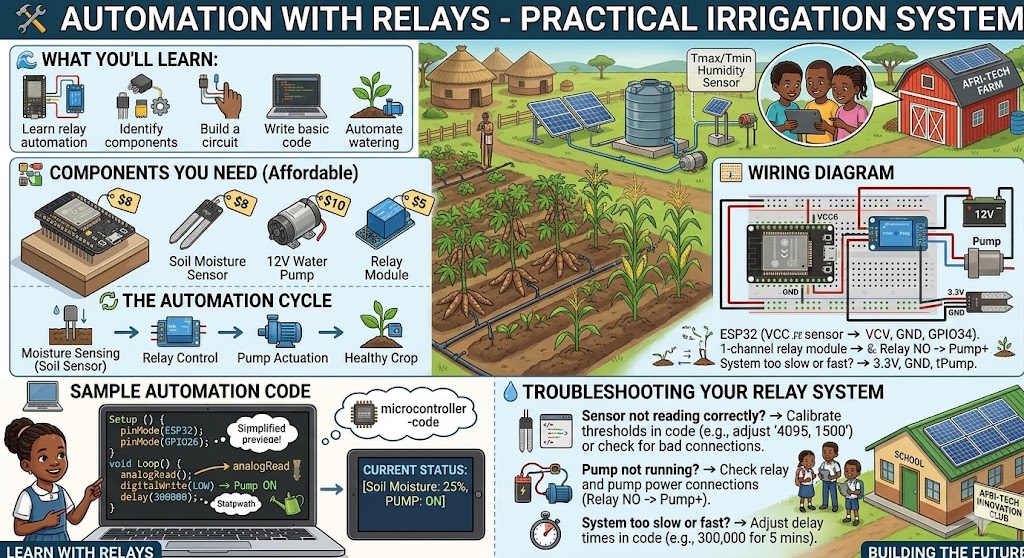
- 🔹 ESP32 microcontroller — $8 · Brain of the system
- 🔹 1-Channel Relay Module — $5 · Controls pump on/off
- 🔹 Soil Moisture Sensor — $8 · Measures soil water content
- 🔹 12V Water Pump — $10 · Pumps water to crops
- 🔹 Water tubing & fittings — $5 · Distribute water to plants
- 🔹 12V Power Supply — $8 · Powers pump and ESP32
💡 Total System Cost: ~$44
Pays for itself in 2-3 months through water savings! A typical 1-acre farm saves $120-180/year on water bills.
🔌 Wiring Diagram
ESP32 → Relay Module
GPIO26 → IN pin (control signal)
3.3V   → VCC (relay power)
GND    → GND

Relay → Water Pump (12V circuit)
COM    → Pump positive (+)
NO     → 12V power supply positive (+)
Pump negative → 12V power supply negative (-)

ESP32 → Soil Moisture Sensor
GPIO34 (ADC) → AO (analog out)
3.3V         → VCC
GND          → GND
⚠️ CRITICAL SAFETY WARNING:
Never connect the pump directly to ESP32 pins! The pump draws 200-500mA, which will destroy your ESP32. ALWAYS use a relay module to isolate high-power circuits.
📖 Complete Automation Code
#include <WiFi.h>

#define RELAY_PIN 26
#define SOIL_PIN 34

const int DRY_THRESHOLD = 30;      // Water when below 30%
const int WET_THRESHOLD = 70;      // Stop watering at 70%
const unsigned long PUMP_RUN_TIME = 300000;  // 5 minutes
const unsigned long CHECK_INTERVAL = 3600000; // Check every hour

unsigned long lastCheck = 0;
bool pumpRunning = false;
unsigned long pumpStartTime = 0;

void setup() {
    Serial.begin(115200);
    pinMode(RELAY_PIN, OUTPUT);
    digitalWrite(RELAY_PIN, HIGH);  // Relay HIGH = Pump OFF (active low)
    Serial.println("🌱 Auto Irrigation System Started");
}

int getSoilMoisturePercent() {
    int raw = analogRead(SOIL_PIN);
    // Sensor dry: 4095, Sensor wet: 1500 (adjust based on your soil)
    int percent = map(raw, 4095, 1500, 0, 100);
    percent = constrain(percent, 0, 100);
    return percent;
}

void startPump() {
    digitalWrite(RELAY_PIN, LOW);  // Pump ON
    pumpRunning = true;
    pumpStartTime = millis();
    Serial.println("💧 PUMP ON - Watering crops");
}

void stopPump() {
    digitalWrite(RELAY_PIN, HIGH);  // Pump OFF
    pumpRunning = false;
    Serial.println("💧 PUMP OFF - Watering complete");
}

void loop() {
    unsigned long now = millis();

    // Handle active pump timer
    if (pumpRunning && (now - pumpStartTime >= PUMP_RUN_TIME)) {
        stopPump();
    }

    // Check soil moisture every hour
    if (!pumpRunning && (now - lastCheck >= CHECK_INTERVAL)) {
        lastCheck = now;

        int moisture = getSoilMoisturePercent();
        Serial.printf("📊 Soil moisture: %d%%\n", moisture);

        if (moisture < DRY_THRESHOLD) {
            Serial.println("⚠️ Soil too dry! Starting pump...");
            startPump();
        } else if (moisture > WET_THRESHOLD) {
            Serial.println("✅ Soil moisture is good. No watering needed.");
        } else {
            Serial.printf("🌿 Soil moisture optimal (%d%%). No action needed.\n", moisture);
        }
    }
}
💡 Adjusting Moisture Thresholds by Crop:
- Tomatoes: Water at 25% dry, stop at 65%
- Maize/Corn: Water at 20% dry, stop at 60%
- Leafy greens: Water at 35% dry, stop at 75%
- Succulents/Drought crops: Water at 15% dry, stop at 50%
📖 Case Study — Smart Irrigation Saves 55% Water, Kenya:
A tomato farmer replaced timer-based irrigation with soil moisture sensors:
- 💧 Water savings: 55% reduction (from 8,000L to 3,600L/week)
- 💰 Cost savings: $65/month on water bills
- 📈 Yield increase: 28% better tomato production (no over/under watering)
- ⚡ Power: Solar-powered ESP32 runs 6+ months
"My tomatoes never looked better. The system paid for itself in 6 weeks!" — Farmer, Kiambu County
🌟 Advanced Features to Add:
- 📱 Remote monitoring: Add WiFi to see moisture from your phone
- 🌧️ Rain delay: Add a rain sensor to skip watering
- ⏰ Time restrictions: Water only in morning/evening (prevents evaporation)
- 📊 Data logging: Track moisture trends over weeks
🎯 Key Takeaways:
- ✅ Relay modules protect your ESP32 from high-power devices (pumps, valves, lights)
- ✅ Soil moisture sensors save 40-60% water compared to timers
- ✅ Different crops need different moisture thresholds — adjust for your farm
- ✅ Always add a max run time (fail-safe) to prevent flooding
- ✅ This $44 system pays for itself in 2-3 months through water savings
💡 Key Takeaways:
- Apply these concepts directly to your farm or project.
- Take notes on important details for the quiz.
- Use the button below to track your progress.
×
![Enlarged view]()