Weather Parameters That Affect Crops
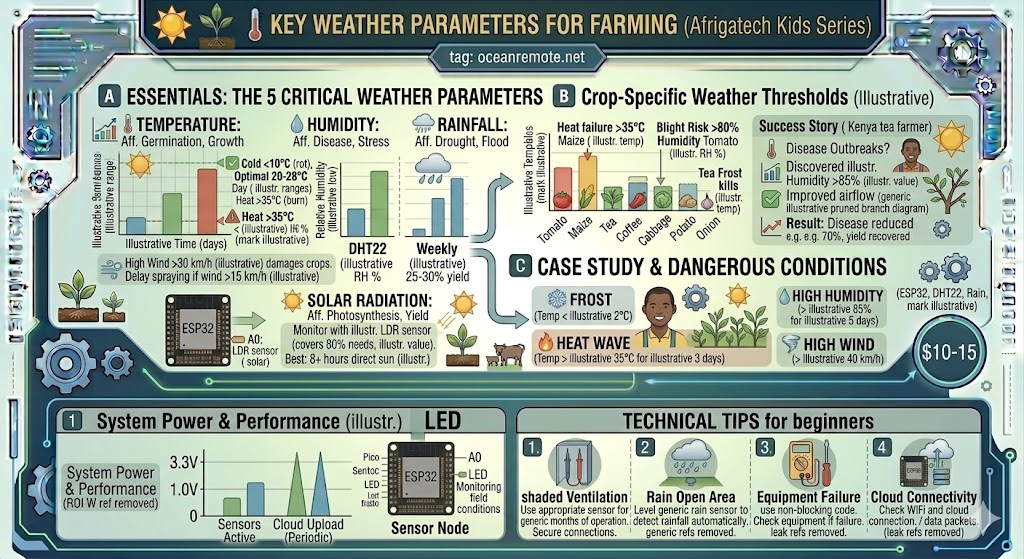
🌡️ Key Weather Parameters for Farming - Understanding What to Measure
🌡️ What You'll Learn:
- 🌡️ Understand which weather parameters impact your crops the most
- 📊 Learn optimal ranges for temperature, humidity, and rainfall
- 🌾 Know crop-specific thresholds for tomatoes, maize, tea, and coffee
- ⚠️ Identify when weather conditions become dangerous for crops
Weather determines farming success. Temperature, humidity, rainfall, wind, and solar radiation all affect crop growth, disease risk, and yield. Understanding these parameters helps you make better decisions about planting, irrigation, and crop protection.
📊 The 5 Critical Weather Parameters
🌡️ 1. Temperature
- Affects germination, growth rate, flowering, and fruiting
- Too cold (< 10°C): Seeds rot, growth stops, frost kills plants
- Too hot (> 35°C): Pollination fails, fruits drop, leaves burn
- Optimal for most crops: 20-28°C during day, 15-20°C at night
💧 2. Humidity
- High humidity (> 85%): Promotes fungal diseases (mold, mildew, rot)
- Low humidity (< 40%): Causes plant stress, wilting, poor fruit set
- Optimal for most crops: 60-75% relative humidity
- Greenhouse tip: Ventilate when humidity exceeds 80%
🌧️ 3. Rainfall
- Most vegetables need 25-50mm (1-2 inches) per week
- Too little (< 10mm/week): Drought stress, irrigation required
- Too much (> 75mm/week): Flooding, root rot, nutrient leaching
- Track daily rainfall to adjust irrigation schedules
💨 4. Wind Speed
- Affects evapotranspiration (increases water loss from soil and plants)
- High wind (> 30 km/h): Damages tall crops (maize, sunflowers)
- Spray application: Never spray pesticides when wind > 15 km/h (drift risk)
- Windbreaks (trees, fences) reduce wind damage by 50-70%
☀️ 5. Solar Radiation
- Essential for photosynthesis - plants convert sunlight into energy
- Low light (< 4 hours direct sun): Poor yields, leggy plants
- High light (8+ hours direct sun): Best for most vegetables
- Monitor using light sensor (LDR) or pyranometer
For most farmers, start with temperature and humidity. A $5 DHT22 gives you both. Add rain detection next ($3 sensor), then wind ($15) if you spray pesticides or grow tall crops. Solar radiation is useful but usually correlates with temperature.
📊 Crop-Specific Weather Thresholds
- 🍅 Tomatoes: 20-25°C, 65-75% humidity. Stop setting fruit above 32°C. Blight risk when humidity > 80% for 3+ days.
- 🌽 Maize (Corn): 18-30°C, 60-80% humidity. Critical tasseling period needs consistent soil moisture. Heat above 35°C reduces pollination.
- 🍵 Tea: 15-25°C, 70-85% humidity. Grows best in humid highlands. Frost kills young shoots.
- ☕ Coffee: 18-22°C, 65-80% humidity. Flowering triggered by dry period followed by rain. Direct sun > 30°C reduces quality.
- 🌶️ Peppers: 20-28°C, 60-70% humidity. Blossom drop above 32°C, fruit rot when too humid.
- 🥬 Cabbage: 15-20°C, 70-80% humidity. Bolting (flowering) triggered by cold below 10°C.
- 🥔 Potatoes: 15-20°C, 60-70% humidity. Late blight risk when wet & cool for extended periods.
- 🧅 Onions: 13-25°C, 60-70% humidity. Bulbing triggered by day length, not just temperature.
A tea farmer in Kericho, Kenya installed a weather station to track humidity:
- 🌡️ Problem: Frequent leaf rust outbreaks reduced yield by 25%
- 📊 Discovery: Humidity exceeded 85% for 6+ hours daily
- ✅ Solution: Improved air circulation, pruned for better airflow
- 📈 Result: Leaf rust reduced by 70%, yield recovered
"Knowing our microclimate humidity helped us fix disease problems we didn't even know we had." - Tea Farmer, Kenya
- ❄️ Frost (Temp < 2°C): Kills tomatoes, beans, peppers. Cover crops or irrigate before dawn.
- 🔥 Heat wave (Temp > 35°C for 3+ days): Pollination fails, fruit drops. Increase irrigation by 50%.
- 💧 High humidity (> 85% for 5+ days): Fungal disease outbreak. Ventilate, apply fungicide.
- 🌪️ High wind (> 40 km/h): Lodging (crops fall over). Delay planting until wind passes.
- Priority 1 ($10): DHT22 - Temperature + Humidity (covers 80% of needs)
- Priority 2 ($3): Rain sensor - Detect rainfall for irrigation decisions
- Priority 3 ($5): BMP280 - Barometric pressure for weather forecasting
- Priority 4 ($15): Anemometer - Wind speed for spray application
- Priority 5 ($5): LDR light sensor - Solar radiation
- ✅ Temperature + humidity are the most critical weather parameters (start with DHT22)
- ✅ Most crops thrive at 20-28°C day, 60-75% humidity
- ✅ Humidity > 85% for multiple days = fungal disease risk
- ✅ Temperature > 35°C = heat stress, pollination failure
- ✅ Wind > 15 km/h = delay pesticide spraying (drift risk)
- ✅ Crop-specific thresholds help you anticipate problems before they occur
Next lesson: Using DHT22 for Weather Monitoring
- Apply these concepts directly to your farm or project.
- Take notes on important details for the quiz.
- Use the button below to track your progress.