← Back to Course
Soil Moisture Sensors Basics
🌱 Understanding Soil Moisture - The Foundation of Healthy Crops
🌱 What You'll Learn:
- 💧 Understand what soil moisture is and why it matters for crop health
- 📊 Learn ideal moisture ranges for maize, tomatoes, vegetables, wheat, and onions
- ⚠️ Identify signs of over-watering (root rot) and under-watering (wilting)
- 🌾 Adjust watering based on your soil type (sandy vs clay)
Soil moisture is the water content held in the spaces between soil particles. It's one of the most important measurements for crop health. Get it wrong, and your yields suffer. Get it right, and your plants thrive.
💧 Why Soil Moisture Matters
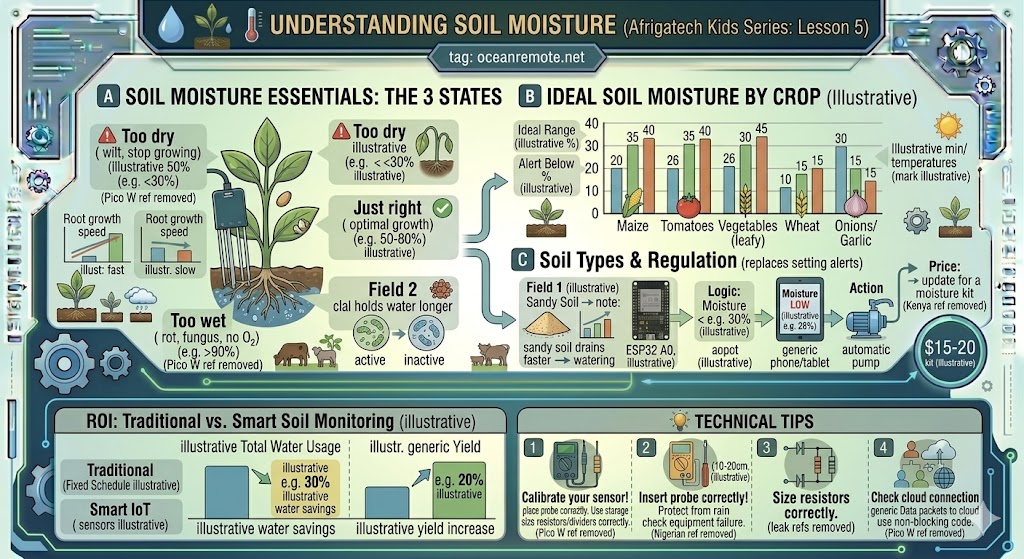
- 🥀 Too dry (< 30%): Plants wilt, stop growing, stomata close, and eventually die. Roots cannot absorb nutrients from dry soil.
- 💦 Too wet (> 85%): Roots rot from lack of oxygen, fungus gnats and mold appear, beneficial soil bacteria die.
- ✅ Just right (40-75%): Plants grow strong, roots develop deep, nutrients are available, beneficial microbes thrive.
💡 The Goldilocks Zone for Soil Moisture:
Most crops thrive when soil moisture stays between 40-75%. Below 30%, plants experience drought stress. Above 85%, roots suffocate from lack of oxygen. The sweet spot depends on your crop and soil type.
📊 Ideal Soil Moisture Levels by Crop
- 🌽 Maize (Corn): Ideal 60-75% | Alert below 50% | Critical below 35%
- 🍅 Tomatoes: Ideal 65-80% | Alert below 55% | Critical below 40%
- 🥬 Leafy Vegetables (cabbage, lettuce): Ideal 70-85% | Alert below 60% | Critical below 45%
- 🌾 Wheat: Ideal 55-70% | Alert below 45% | Critical below 30%
- 🧅 Onions/Garlic: Ideal 50-65% | Alert below 40% | Critical below 25%
- 🌶️ Peppers: Ideal 60-75% | Alert below 50% | Critical below 35%
- 🥔 Potatoes: Ideal 55-70% | Alert below 45% | Critical below 30%
- 🥕 Carrots: Ideal 55-70% | Alert below 45% | Critical below 30%
- 🌿 Beans: Ideal 50-65% | Alert below 40% | Critical below 25%
📖 Case Study - Over-Watering Kills Tomato Crop:
A tomato farmer irrigated daily for 30 minutes, keeping soil at 85-90% moisture:
- 🍅 Symptoms: Yellow lower leaves, stunted growth, root rot
- 🔬 Diagnosis: Soil too wet (85-90%) for 2+ weeks
- ✅ Fix: Reduced irrigation to every 3 days, kept moisture at 65%
- 📈 Result: Plants recovered, yield increased 40%
"I thought more water meant more growth. I was wrong. Over-watering nearly killed my entire crop." - Tomato Farmer, Nigeria
🌾 Soil Type Makes a Big Difference
- 🏜️ Sandy Soil: Drains fast, needs watering every 1-2 days. Ideal moisture range: 40-60%. React quickly to dry conditions.
- 🌾 Loamy Soil (Best): Perfect balance, needs watering every 3-5 days. Ideal moisture range: 50-70%. Most forgiving.
- 🧴 Clay Soil: Holds water for 7-10 days. Ideal moisture range: 60-75%. Water slowly to prevent runoff.
- 🪨 Sandy Loam: Good drainage, moderate water holding. Ideal moisture range: 45-65%. Water every 2-4 days.
⚠️ Signs of Incorrect Soil Moisture:
- 🌵 Signs of UNDER-watering: Wilting leaves (especially in afternoon), dry crumbly soil, yellow lower leaves, stunted growth.
- 💧 Signs of OVER-watering: Yellow leaves (all over), mold on soil surface, root rot smell, fungus gnats, slow growth.
- 🔧 Rule of thumb: Stick finger 5cm into soil. If dry at fingertip → water. If wet → wait. If sticky and muddy → stop watering!
💡 How to Test Your Soil Type:
- Squeeze test: Take handful of moist soil. Squeeze firmly.
- Sandy: Falls apart immediately when you open your hand.
- Loamy: Forms a ball that breaks apart when poked.
- Clay: Forms a tight ball that stays together, feels sticky.
- Why it matters: Sandy soil needs 2-3x more frequent watering than clay!
🎯 Key Takeaways:
- ✅ Ideal soil moisture for most crops: 40-75% (crop dependent)
- ✅ Below 30% = drought stress, above 85% = root rot risk
- ✅ Sandy soil needs watering every 1-2 days; clay soil every 7-10 days
- ✅ Leafy vegetables need highest moisture (70-85%)
- ✅ Onions and garlic are most drought tolerant (50-65%)
- ✅ Check soil moisture with your finger before irrigating
Next step: Install a capacitive soil moisture sensor to measure accurately!
💡 Key Takeaways:
- Apply these concepts directly to your farm or project.
- Take notes on important details for the quiz.
- Use the button below to track your progress.
×
![Enlarged view]()