← Back to Course
Making Decisions from Data
🧠 Making Smart Decisions from Sensor Data
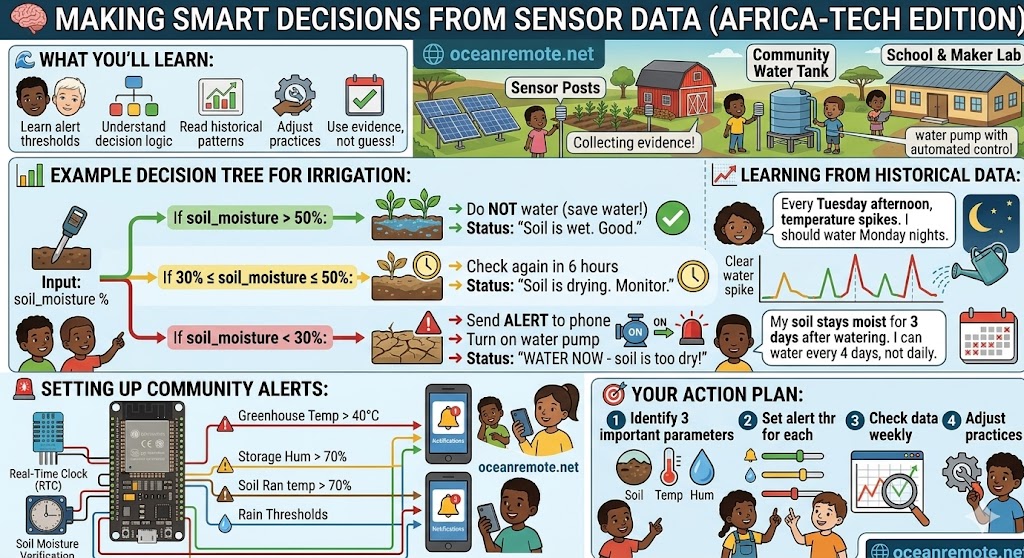
📊 What You'll Learn:
- 🧠 Create decision trees for automated irrigation
- 🚨 Set up alerts for critical farm conditions
- 📈 Learn from historical data to optimize watering schedules
- 💰 Save water and increase yields with data-driven decisions
📊 Example Decision Tree for Irrigation
If soil_moisture > 50%:
    → Do NOT water (save water!)
    → Status: "🌊 Soil is wet. Good."

If 30% ≤ soil_moisture ≤ 50%:
    → Check again in 6 hours
    → Status: "🌿 Soil is drying. Monitor."

If soil_moisture < 30%:
    → Send ALERT to phone
    → Turn on water pump (if automated)
    → Status: "⚠️ WATER NOW - soil is too dry!"
💡 Why Decision Trees Work:
A decision tree removes guesswork. Instead of asking "Should I water today?" you simply follow the rules. Farmers using decision trees save 30-50% more water than those using timers or gut feelings.
🚨 Setting Up Alerts in OceanRemote
-
🌡️ Temperature Alert
Send notification when greenhouse exceeds 40°C
💡 Prevents crop heat stress and wilting -
💧 Humidity Alert
Warn when storage humidity > 70% (risk of mold)
💡 Protects harvested crops from spoilage -
🌱 Soil Moisture Alert
Notify when below 30% (time to water)
💡 Prevents drought stress before visible wilting -
🌧️ Rain Alert
Suspend irrigation automatically when rain detected
💡 Saves water by not watering before rain
⚠️ Alert Best Practices:
- Set multiple thresholds (warning at 35°C, critical at 40°C)
- Test alerts during normal conditions to avoid false alarms
- Add time delays (e.g., alert only if dry for 2+ hours) to prevent notification spam
- Always have a fallback contact (neighbor or farm manager) if you miss the alert
📈 Learning from Historical Data
-
📅 Pattern Discovery #1:
"Every Tuesday afternoon, temperature spikes. I should water Monday nights."
💧 Result: Plants are hydrated before heat arrives -
📅 Pattern Discovery #2:
"My soil stays moist for 3 days after watering. I can water every 4 days, not daily."
💧 Result: 75% reduction in water usage! -
📅 Pattern Discovery #3:
"Last month I watered 15 times. This month with sensors, I only watered 9 times."
💧 Result: 40% less water, healthier plants (no over-watering)
📖 Case Study — Data-Driven Decisions Save $2,000, Ghana:
A pepper farmer analyzed 3 months of soil moisture data:
- 📊 Discovery: Soil stayed wet for 4 days after watering (not 2 days as assumed)
- ✅ Action: Changed schedule from every 2 days to every 4 days
- 💧 Water savings: 50% reduction (from 20,000L to 10,000L/week)
- 💰 Cost savings: $2,000/year on water + electricity
- 📈 Yield increase: 20% more peppers (reduced over-watering stress)
"I used to water every other day because that's what my neighbor did. The data showed I was wasting water. Now my peppers are bigger and my bills are smaller." — Farmer, Central Region
🎯 Your Action Plan:
- Identify 3 important parameters on your farm (soil moisture, temperature, humidity)
- Set alert thresholds for each (e.g., water when moisture < 30%)
- Check data weekly to find patterns (same day, same time each week)
- Adjust your farming practices based on evidence, not guessing!
- 📝 Track your savings in a notebook — you'll be amazed at the difference
💡 Sample Code for Automated Decision Making:
// Complete decision logic for your ESP32
int moisture = getSoilMoisturePercent();
float temp = dht.readTemperature();

if (moisture < 25) {
    sendAlert("CRITICAL: Soil moisture below 25%!");
    digitalWrite(RELAY_PIN, LOW);  // Start pump
    delay(600000);  // Water for 10 minutes
    digitalWrite(RELAY_PIN, HIGH);
}
else if (moisture < 35 && temp > 32) {
    // Hot + moderately dry = water
    digitalWrite(RELAY_PIN, LOW);
    delay(300000);  // Water for 5 minutes
    digitalWrite(RELAY_PIN, HIGH);
}
else if (moisture > 65) {
    sendAlert("Soil too wet! Check drainage.");
}
⚠️ Common Decision-Making Mistakes:
- ❌ Reacting to single readings: One false reading can trigger wrong actions. Average 3-5 readings.
- ❌ Ignoring time of day: Soil moisture drops at 2pm due to evaporation, but recovers at night.
- ❌ No fail-safes: Always add max run time to pumps in case sensor fails.
- ❌ Not reviewing historical data: Weekly reviews reveal patterns you'd miss day-to-day.
- ❌ Same thresholds for all crops: Tomatoes need more water than maize. Adjust per crop!
🎯 Key Takeaways:
- ✅ Decision trees remove guesswork — follow simple rules for consistent results
- ✅ Set alerts for critical conditions: temperature (>40°C), moisture (<30%), humidity (>70%)
- ✅ Review historical data weekly to discover patterns you'd otherwise miss
- ✅ Farmers using data-driven decisions save 30-50% water and increase yields 15-25%
- ✅ Always add fail-safes (max run time) and time delays to prevent false alarms
- ✅ Your action plan: Identify 3 parameters → Set thresholds → Review weekly → Adjust practices
💡 Key Takeaways:
- Apply these concepts directly to your farm or project.
- Take notes on important details for the quiz.
- Use the button below to track your progress.
×
![Enlarged view]()