← Back to Course
ESP32 Sleep Modes Overview
💤 ESP32 Sleep Modes - Maximizing Battery Life
🔋 What You'll Learn in This Lesson:
- 💤 Choose the right sleep mode for your application
- 📊 Reduce power from 150mA to 2.5μA (60,000x reduction!)
- 🔄 Preserve data using RTC memory across deep sleep
- ⏰ Wake ESP32 on timer, button press, or sensor trigger
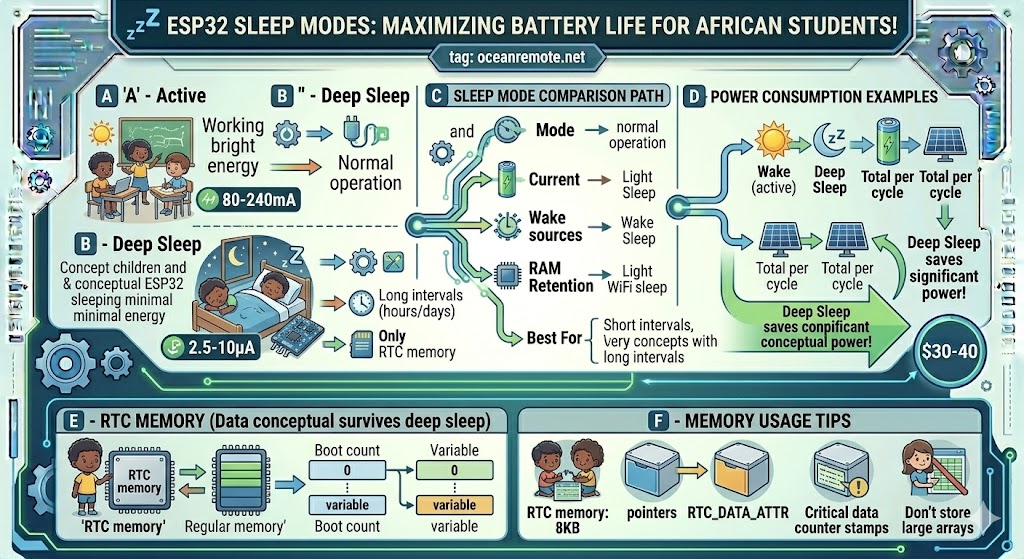
ESP32 has several sleep modes that dramatically reduce power consumption. A 2600mAh battery lasts only 17 hours in active mode but can last over 10 years in deep sleep! The key is sleeping between readings.
📊 Sleep Mode Comparison
| Mode | Current | Wake Sources | RAM Retention | Best For | |||||||||||||||||
|---|---|---|---|---|---|---|---|---|---|---|---|---|---|---|---|---|---|---|---|---|---|
| Active | 80-240mA
💡 Key Insight:
The 60,000x power reduction from active mode to deep sleep means a battery that lasts 1 day in active mode would last over 100 years in deep sleep! But your sensor still needs to wake up to take readings. 📊 Deep Sleep Code - Most Common for Sensors
#include <esp_sleep.h>

// RTC memory survives deep sleep!
RTC_DATA_ATTR int bootCount = 0;

void setup() {
    Serial.begin(115200);
    bootCount++;

    Serial.printf("Boot #%d\n", bootCount);

    // Read sensors (takes ~1 second)
    int moisture = analogRead(32);
    float temp = readTemperature();

    // Send data (connect WiFi, send, disconnect)
    sendToCloud(moisture, temp);

    // Go to deep sleep for 1 hour
    // 1 hour = 1 * 60 * 60 * 1,000,000 microseconds
    esp_sleep_enable_timer_wakeup(3600000000);
    esp_deep_sleep_start();

    // Code here NEVER runs - ESP32 is sleeping!
}

void loop() {
    // This never runs - everything in setup()
}
📊 Power Consumption Calculation
═══════════════════════════════════════════════════════════════════════════════
                    BATTERY LIFE CALCULATION
═══════════════════════════════════════════════════════════════════════════════

  2600mAh battery, reading every 15 minutes:

  Active mode (5 seconds): 150mA × 5 sec = 0.208mAh
  Deep sleep (895 sec):     2.5μA × 895 sec = 0.00062mAh
  Total per 15min cycle:                   = 0.2086mAh

  Cycles per day: 96
  Daily power use: 96 × 0.2086 = 20mAh/day

  ⚡ Battery life = 2600mAh ÷ 20mAh/day = 130 DAYS!

  Increase to 1 hour intervals → 2+ years battery life!

═══════════════════════════════════════════════════════════════════════════════
💡 RTC Memory - Data That Survives Deep Sleep:
📖 Wake Sources - Triggering from Sleep
// Timer wake (most common for sensors)
esp_sleep_enable_timer_wakeup(3600000000);  // 1 hour

// External GPIO wake (button or sensor trigger)
esp_sleep_enable_ext0_wakeup(GPIO_NUM_0, LOW);  // Wake on button press

// Touch wake (no external button needed)
touchSleepWakeUpEnable(T0, 40);  // Wake on touch

// Light sleep with timer (faster wake, more power)
esp_light_sleep_start();
⚠️ Common Deep Sleep Mistakes:
📖 Case Study - 2+ Years on Two AA Batteries:
A soil moisture sensor in remote Kenya needed long battery life:
"We check data weekly and haven't replaced batteries in 20 months." - Field Technician, Kenya
🎉 Key Takeaways:
Pro tip: Always test your sleep current with a multimeter - you should see microamps, not milliamps!
💡 Key Takeaways:
×
|