Predicting Irrigation Needs
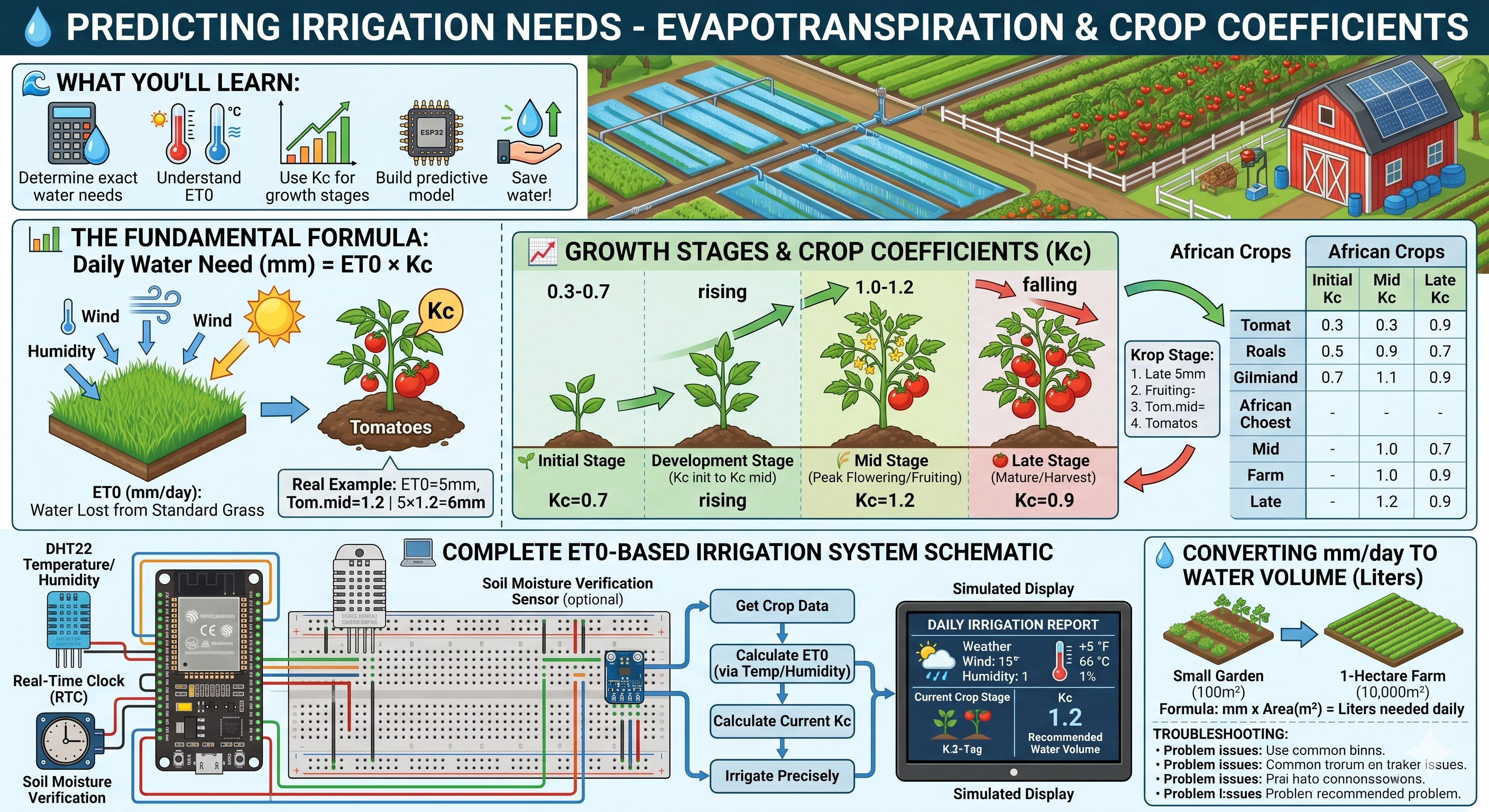
💧 Predicting Irrigation Needs - Evapotranspiration & Crop Coefficients
🌾 What You'll Learn in This Lesson:
- 💧 Calculate exactly how much water your crops need daily
- 🌡️ Understand Evapotranspiration (ET0) and why it matters
- 📊 Use Crop Coefficients (Kc) for different growth stages
- 💻 Build a predictive irrigation model with Arduino/ESP32
- 💰 Save water by irrigating precisely when and how much needed
📚 What is Evapotranspiration (ET0)?
Evapotranspiration (ET) is the sum of evaporation from soil + transpiration from plants. ET0 is the reference evapotranspiration from a standard grass surface - basically, how much water is naturally leaving your field each day!
Water leaves your farm through two processes:
- 💧 Evaporation: Water evaporating directly from soil surface
- 🌿 Transpiration: Water moving through plants and evaporating from leaves
| Climate Factor | Effect on ET0 | Irrigation Impact |
|---|---|---|
| ☀️ High Temperature | ↑ Increases ET0 | ⬆️ Need more water |
| 💨 Strong Wind | ↑ Increases ET0 | ⬆️ Need more water |
| 💧 High Humidity | ↓ Decreases ET0 | ⬇️ Need less water |
| ☁️ Cloud Cover | ↓ Decreases ET0 | ⬇️ Need less water |
| 🌞 Full Sun | ↑ Increases ET0 | ⬆️ Need more water |
📊 The Basic Formula
Daily Water Need (mm) = ET0 × Kc
Where:
ET0 = Reference evapotranspiration (mm/day) - water lost from grass
Kc = Crop Coefficient (depends on crop type and growth stage)
If ET0 = 5mm (hot, sunny day) and Kc for tomatoes at flowering = 1.2
Daily water need = 5 × 1.2 = 6mm
That's 6 liters per square meter, or 60,000 liters per hectare daily!
🌽 Crop Coefficients (Kc) for Common African Crops
| Crop | Initial Stage (Kc init) | Mid Stage (Kc mid) | Late Stage (Kc end) | Total Days |
|---|---|---|---|---|
| 🌽 Maize (Corn) | 0.3 | 1.2 | 0.6 | 100-120 |
| 🍅 Tomatoes | 0.6 | 1.2 | 0.9 | 90-120 |
| 🌶️ Peppers | 0.6 | 1.1 | 0.9 | 90-110 |
| 🥬 Cabbage | 0.7 | 1.1 | 0.95 | 80-100 |
| 🧅 Onions | 0.7 | 1.1 | 0.9 | 120-150 |
| 🥕 Carrots | 0.7 | 1.1 | 0.9 | 70-90 |
| 🍆 Eggplant | 0.6 | 1.1 | 0.9 | 100-120 |
| 🍉 Watermelon | 0.5 | 1.1 | 0.8 | 80-100 |
| 🥔 Potatoes | 0.5 | 1.2 | 0.9 | 90-110 |
| 🍓 Strawberries | 0.5 | 1.0 | 0.8 | 120-150 |
| 🌾 Rice (paddy) | 1.1 | 1.2 | 1.0 | 120-150 |
| 🌿 Beans (dry) | 0.5 | 1.1 | 0.8 | 80-100 |
| 🥜 Groundnuts | 0.5 | 1.1 | 0.7 | 100-120 |
| 🫘 Cowpeas | 0.4 | 1.0 | 0.8 | 70-90 |
| 📦 Sorghum | 0.4 | 1.1 | 0.6 | 90-110 |
| 🌻 Sunflower | 0.4 | 1.1 | 0.6 | 90-110 |
| 🍌 Bananas | 0.5 | 1.2 | 1.0 | 300-365 |
| 🍊 Citrus | 0.7 | 0.7 | 0.7 | 365 |
📈 Growth Stages Explained
🌡️ Calculating ET0 - The Hargreaves Method
You can estimate ET0 using temperature data (no complex weather station needed!):
/*
 * ET0 Calculator using Hargreaves Method
 * Only needs min/max temperature and solar radiation
 *
 * Formula: ET0 = 0.0023 × RA × (Tavg + 17.8) × √(Tmax - Tmin)
 *
 * Where:
 * - RA = Extraterrestrial radiation (MJ/m²/day)
 * - Tavg = Average daily temperature (°C)
 * - Tmax = Maximum daily temperature (°C)
 * - Tmin = Minimum daily temperature (°C)
 */

float calculateET0(float tmax, float tmin, float latitude, int dayOfYear) {
    // Calculate extraterrestrial radiation (RA)
    // Simplified formula - use actual for production

    float tavg = (tmax + tmin) / 2.0;
    float tempDiff = sqrt(tmax - tmin);

    // RA depends on latitude and day of year
    // For latitude 0° (equator), RA ≈ 35 MJ/m²/day
    float RA = 35.0; // Simplified - use actual calculation in production

    float ET0 = 0.0023 * RA * (tavg + 17.8) * tempDiff;

    return ET0;
}
💧 Converting mm/day to Actual Water Volume
📐 Conversion Formula:
Daily Water (liters) = ET0 × Kc × Area (m²)
Example 1 - Small Garden (100m²):
ET0 = 5mm, Kc (tomatoes mid) = 1.2
Water need = 5 × 1.2 × 100 = 600 liters/day
Example 2 - 1 Hectare Farm (10,000m²):
ET0 = 4mm, Kc (maize mid) = 1.2
Water need = 4 × 1.2 × 10,000 = 48,000 liters/day
That's 4 tanker trucks daily!
💻 Arduino Code: Complete ET0-Based Irrigation Predictor
/* * Predictive Irrigation System using ET0 + Kc * Calculates daily water requirements based on weather * * Components: * - DHT22 (temperature, humidity) * - Soil moisture sensor (optional verification) * - Real-time clock (RTC) for day counting */ #include#include #include #define DHTPIN 4 #define DHTTYPE DHT22 DHT dht(DHTPIN, DHTTYPE); RTC_DS3231 rtc; // Crop configuration struct CropData { const char* name; float kcInit; float kcMid; float kcEnd; int daysInit; // Days in initial stage int daysMid; // Days in mid stage (after init) int daysLate; // Days in late stage int totalDays; }; // Define your crops CropData crops[] = { {"Tomatoes", 0.6, 1.2, 0.9, 30, 50, 30, 110}, {"Maize (Corn)", 0.3, 1.2, 0.6, 25, 60, 25, 110}, {"Peppers", 0.6, 1.1, 0.9, 25, 50, 25, 100}, {"Beans", 0.5, 1.1, 0.8, 20, 45, 25, 90} }; int currentCrop = 0; // Index of selected crop int daysAfterPlanting = 45; // Example: 45 days after planting // Calculate current Kc based on growth stage float getCurrentKc(CropData crop, int daysAfterPlanting) { if (daysAfterPlanting <= crop.daysInit) { return crop.kcInit; } else if (daysAfterPlanting <= (crop.daysInit + crop.daysMid)) { return crop.kcMid; } else if (daysAfterPlanting <= crop.totalDays) { return crop.kcLate; } else { return crop.kcEnd; // Harvest stage } } // Calculate ET0 using temperature-based method float calculateET0(float tmax, float tmin, float humidity) { // Simplified Priestley-Taylor method // For production, use FAO Penman-Monteith float tavg = (tmax + tmin) / 2.0; // Simple linear estimate based on temperature // ET0 typically ranges 2-8mm/day in Africa float baseET = 3.0; // mm/day baseline float tempFactor = (tavg - 20) * 0.15; float ET0 = baseET + tempFactor; // Adjust for humidity if (humidity > 70) { ET0 = ET0 * 0.7; // High humidity reduces evaporation } else if (humidity < 40) { ET0 = ET0 * 1.3; // Low humidity increases evaporation } return constrain(ET0, 1.5, 10.0); } // Calculate daily water need in liters for your area float calculateDailyWaterNeeds(float ET0, float Kc, float areaSqMeters) { float waterMM = ET0 * Kc; // mm of water needed float waterLiters = waterMM * areaSqMeters; // 1mm over 1m² = 1 liter return waterLiters; } // Get growth stage name String getGrowthStage(CropData crop, int daysAfterPlanting) { if (daysAfterPlanting <= crop.daysInit) { return "Initial (Germination)"; } else if (daysAfterPlanting <= (crop.daysInit + crop.daysMid)) { return "Mid (Flowering/Fruiting)"; } else { return "Late (Ripening/Harvest)"; } } void setup() { Serial.begin(115200); dht.begin(); if (!rtc.begin()) { Serial.println("Couldn't find RTC!"); } Serial.println("========================================"); Serial.println("💧 PREDICTIVE IRRIGATION SYSTEM v1.0"); Serial.println(" ET0 + Crop Coefficient Method"); Serial.println("========================================\n"); } void loop() { // Read temperature and humidity float temp = dht.readTemperature(); float humidity = dht.readHumidity(); // Get crop data CropData crop = crops[currentCrop]; float Kc = getCurrentKc(crop, daysAfterPlanting); String stage = getGrowthStage(crop, daysAfterPlanting); // Calculate ET0 float ET0 = calculateET0(temp, temp - 5, humidity); // Calculate water needs for different area sizes float gardenWater = calculateDailyWaterNeeds(ET0, Kc, 100); // 100m² garden float halfHectare = calculateDailyWaterNeeds(ET0, Kc, 5000); // 0.5 hectare float oneHectare = calculateDailyWaterNeeds(ET0, Kc, 10000); // 1 hectare // Display report Serial.println("╔══════════════════════════════════════════════════════════════╗"); Serial.println("║ 📊 DAILY IRRIGATION PREDICTION REPORT ║"); Serial.println("╚══════════════════════════════════════════════════════════════╝"); Serial.println(""); Serial.println("🌡️ WEATHER CONDITIONS:"); Serial.printf(" Temperature: %.1f°C\n", temp); Serial.printf(" Humidity: %.1f%%\n", humidity); Serial.printf(" Calculated ET0: %.1f mm/day\n", ET0); Serial.println(""); Serial.println("🌾 CROP INFORMATION:"); Serial.printf(" Crop: %s\n", crop.name); Serial.printf(" Days after planting: %d\n", daysAfterPlanting); Serial.printf(" Growth stage: %s\n", stage.c_str()); Serial.printf(" Current Kc: %.2f\n", Kc); Serial.printf(" Kc range: %.1f → %.1f → %.1f\n", crop.kcInit, crop.kcMid, crop.kcEnd); Serial.println(""); Serial.println("💧 DAILY WATER REQUIREMENTS:"); Serial.printf(" 🏡 Garden (100m²): %.0f liters (%.0f jerry cans)\n", gardenWater, gardenWater / 20); Serial.printf(" 🌾 Half hectare: %.0f liters (%.0f tanker trucks)\n", halfHectare, halfHectare / 10000); Serial.printf(" 🚜 1 Hectare: %.0f liters (%.0f tanker trucks)\n", oneHectare, oneHectare / 10000); Serial.println(""); Serial.println("🎯 IRRIGATION RECOMMENDATION:"); if (ET0 > 6) { Serial.println(" 🔥 High water demand - Irrigate early morning (5-7 AM)"); Serial.println(" 💡 Consider mulching to reduce evaporation"); } else if (ET0 > 4) { Serial.println(" 💧 Moderate water demand - Normal irrigation schedule"); } else { Serial.println(" ✅ Low water demand - Reduce irrigation frequency"); } Serial.println(""); Serial.println("══════════════════════════════════════════════════════════════\n"); delay(3600000); // Update every hour }
📱 Simplified ET0 by Climate Zone (No Sensors Needed!)
| Climate Zone | Typical ET0 (mm/day) | Example Locations | Irrigation Adjustment |
|---|---|---|---|
| 🌧️ Humid/Coastal | 3-4 mm/day | Mombasa, Dar es Salaam, Lagos | ⬇️ Reduce water by 30% |
| 🌤️ Sub-humid | 4-5 mm/day | Nairobi, Kampala, Addis Ababa | ✅ Standard calculation |
| ☀️ Semi-arid | 5-7 mm/day | Kigali, Lilongwe, Lusaka | ⬆️ Increase water by 25% |
| 🏜️ Arid/Desert | 7-10 mm/day | Cairo, Khartoum, Nouakchott | ⬆️ Increase water by 50-75% |
A 5-hectare maize farm in Nakuru, Kenya implemented ET0-based irrigation:
- 📊 Before: Irrigated 2 hours daily regardless of weather (24mm/day)
- 🔬 Method: Calculated ET0 = 4.5mm, Kc maize peak = 1.2 → Need = 5.4mm/day
- 💧 Saved: 18.6mm/day excess watering → 93,000 liters/hectare DAILY saved!
- 💰 Annual savings: $2,800 on water + electricity
- 🌽 Yield impact: 15% increase (reduced over-watering)
"We were over-watering by 300% without realizing it. ET0 calculation showed us exactly how much water our maize actually needs." - Farm Manager, Nakuru, Kenya
- 📍 Track daily: ET0 changes with weather. Check daily, not weekly.
- 📍 Rain adjustment: If rain ≥ calculated need, skip irrigation completely.
- 📍 Soil check: Use soil moisture sensor to verify your ET0 calculation.
- 📍 Mobile apps: Apps like "ET Calculator" can give you daily ET0 for your location.
- 📍 Start simple: Use estimated ET0 (3-4mm for humid, 5-7mm for dry areas).
You now understand how to predict irrigation needs scientifically!
- ✅ Understand Evapotranspiration (ET0) and why it matters
- ✅ Use Crop Coefficients (Kc) for different growth stages
- ✅ Calculate daily water needs in mm and liters
- ✅ Build predictive Arduino irrigation system
- ✅ Save 30-50% water by irrigating precisely what crops need
Next step: Combine ET0 prediction with soil moisture sensors for ultimate precision!
┌─────────────────────────────────────────────────────────────────────────────┐
│                    DAILY WATER NEED (mm) = ET0 × Kc                          │
├──────────────┬──────────┬──────────┬──────────┬──────────┬─────────────────┤
│     ET0      │   Kc 0.5  │  Kc 0.7  │  Kc 0.9  │  Kc 1.1  │  Kc 1.2         │
├──────────────┼──────────┼──────────┼──────────┼──────────┼─────────────────┤
│ 3 mm (cool)  │   1.5    │   2.1    │   2.7    │   3.3    │   3.6           │
│ 4 mm (mild)  │   2.0    │   2.8    │   3.6    │   4.4    │   4.8           │
│ 5 mm (warm)  │   2.5    │   3.5    │   4.5    │   5.5    │   6.0           │
│ 6 mm (hot)   │   3.0    │   4.2    │   5.4    │   6.6    │   7.2           │
│ 7 mm (very hot)│ 3.5    │   4.9    │   6.3    │   7.7    │   8.4           │
│ 8 mm (extreme)│ 4.0    │   5.6    │   7.2    │   8.8    │   9.6           │
└──────────────┴──────────┴──────────┴──────────┴──────────┴─────────────────┘

💡 To convert mm to liters: mm × area(m²) = liters needed daily
- Apply these concepts directly to your farm or project.
- Take notes on important details for the quiz.
- Use the button below to track your progress.