← Back to Course
Creating Variable Rate Application Maps
🗺️ Creating Variable Rate Application Maps - Precision Fertilizer Management
🗺️ What You'll Learn:
- 📊 Divide your field into management zones based on soil data
- 💰 Save 30-50% on fertilizer by applying only what each zone needs
- 🗺️ Create zone-based fertilizer recommendations from NPK and pH data
- 📈 Increase yield uniformity across variable field conditions
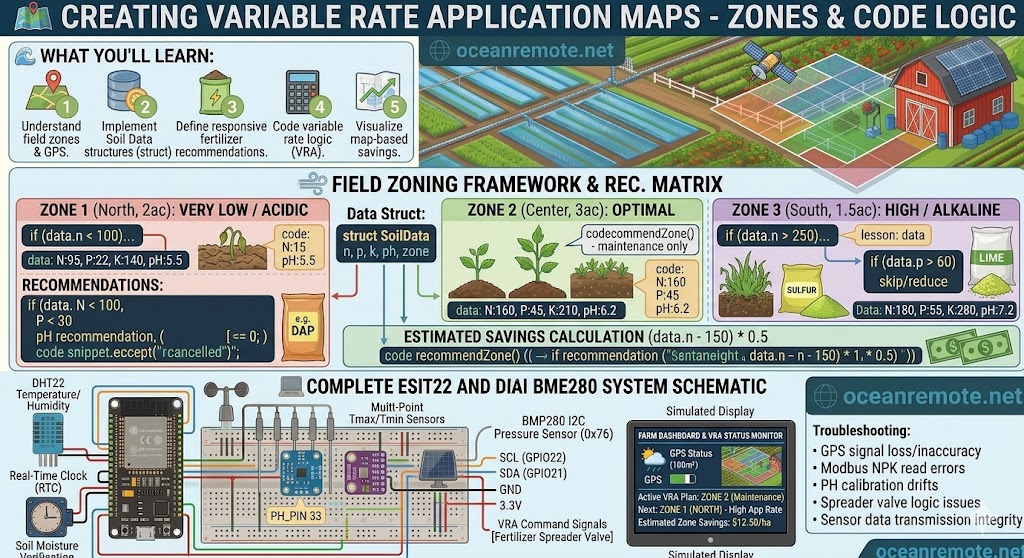
📊 Real Field Example - 6.5 Acre Farm
═══════════════════════════════════════════════════════════════════════════════
                    SOIL TEST RESULTS BY ZONE
═══════════════════════════════════════════════════════════════════════════════

ZONE 1 (North - 2 acres):     ZONE 2 (Center - 3 acres):    ZONE 3 (South - 1.5 acres):
├─ N: 95 mg/kg (VERY LOW)     ├─ N: 160 mg/kg (OPTIMAL)     ├─ N: 180 mg/kg (HIGH)
├─ P: 22 mg/kg (LOW)          ├─ P: 45 mg/kg (OPTIMAL)      ├─ P: 55 mg/kg (HIGH)
├─ K: 140 mg/kg (LOW)         ├─ K: 210 mg/kg (OPTIMAL)     ├─ K: 280 mg/kg (HIGH)
├─ pH: 5.5 (ACIDIC)           ├─ pH: 6.2 (OPTIMAL)          ├─ pH: 7.2 (ALKALINE)

RECOMMENDATIONS:              RECOMMENDATIONS:              RECOMMENDATIONS:
• 200kg/ha 10-20-10           • 50kg/ha 10-10-10            • SKIP nitrogen
• 2kg lime/100m²              • No lime/sulfur              • 1kg sulfur/100m²
• Cost: $85/acre              • Cost: $25/acre              • Cost: $10/acre

═══════════════════════════════════════════════════════════════════════════════
                    COMPARISON: UNIFORM VS VARIABLE RATE
═══════════════════════════════════════════════════════════════════════════════

UNIFORM APPLICATION:           VARIABLE RATE:
• All zones: 100kg/ha 10-10-10 • Zone 1: 200kg/ha 10-20-10
• All zones: 1kg lime/100m²    • Zone 2: 50kg/ha 10-10-10
                                • Zone 3: 0kg N + sulfur

TOTAL COST: $680               TOTAL COST: $420
                                💰 SAVINGS: $260 (38%)
📖 Zone-Based Fertilizer Recommendation Code
struct SoilData { float n, p, k, ph; String zone; int acres; };

void recommendZone(SoilData d) {
    Serial.printf("\n📍 ZONE %s (%d acres)\n", d.zone.c_str(), d.acres);
    Serial.println("─────────────────────────────────");

    // Nitrogen (N)
    if (d.n < 100)      Serial.println("🌿 N: VERY LOW  → 200kg/ha 20-10-10");
    else if (d.n < 150) Serial.println("🌿 N: LOW       → 100kg/ha Urea");
    else if (d.n > 250) Serial.println("🌿 N: EXCESS    → Skip N entirely");
    else                Serial.println("🌿 N: OPTIMAL   → 50kg/ha 10-10-10");

    // Phosphorus (P)
    if (d.p < 20)       Serial.println("🌸 P: VERY LOW  → 150kg/ha DAP");
    else if (d.p < 30)  Serial.println("🌸 P: LOW       → 100kg/ha SSP");
    else if (d.p > 60)  Serial.println("🌸 P: EXCESS    → Skip P");
    else                Serial.println("🌸 P: OPTIMAL   → 50kg/ha SSP");

    // Potassium (K)
    if (d.k < 100)      Serial.println("🍌 K: VERY LOW  → 200kg/ha MOP");
    else if (d.k < 150) Serial.println("🍌 K: LOW       → 100kg/ha MOP");
    else if (d.k > 300) Serial.println("🍌 K: EXCESS    → Skip K");
    else                Serial.println("🍌 K: OPTIMAL   → 50kg/ha MOP");

    // pH
    if (d.ph < 5.5)     Serial.println("🧪 pH: ACIDIC   → 3kg lime/100m²");
    else if (d.ph > 7.5)Serial.println("🧪 pH: ALKALINE → 2kg sulfur/100m²");
    else                Serial.println("🧪 pH: OPTIMAL  → No adjustment");

    // Cost estimate
    float cost = (d.n < 150 ? 85 : 30) + (d.p < 30 ? 40 : 15);
    Serial.printf("💰 Est. cost: $%.0f/acre\n", cost);
}

void setup() {
    Serial.begin(115200);

    SoilData zones[] = {
        {95, 22, 140, 5.5, "1", 2},
        {160, 45, 210, 6.2, "2", 3},
        {180, 55, 280, 7.2, "3", 1},
    };

    for (auto &z : zones) recommendZone(z);
}

void loop() {}
📊 How to Create Your Own Zone Map
- Step 1: Divide field into 3-5 zones based on soil type, slope, or history
- Step 2: Take 5-10 soil samples per zone (mix together for composite)
- Step 3: Send to lab or use portable NPK/pH sensors
- Step 4: Calculate fertilizer needs per zone using code above
- Step 5: Apply at variable rates using GPS-guided spreader
💡 Variable Rate Savings Calculation:
- Uniform application: Apply for the richest zone → waste on poor zones
- Variable rate: Apply exactly what each zone needs
- Typical savings: 30-50% on fertilizer costs ($50-150/acre/year)
- Payback period: Soil testing pays for itself in 1 season
📖 Case Study - 50-Acre Maize Farm:
A farmer divided field into 4 zones based on soil mapping:
- 💰 Before: $12,000/year on uniform fertilizer
- 🗺️ After VRA: $7,200/year on variable rate
- 💵 Savings: $4,800/year (40% reduction)
- 📈 Yield: Increased 15% in poor zones, same in rich zones
⚠️ Common Mistakes:
- ❌ Too few samples per zone (need at least 5-10 cores)
- ❌ Zones too small (minimum 0.5 acre for practical application)
- ❌ Ignoring pH when calculating NPK needs (pH affects availability)
- ❌ Not retesting every 2-3 years (nutrients change)
🎯 Key Takeaways:
- ✅ Divide fields into 3-5 management zones by soil type or history
- ✅ Test each zone separately for N, P, K, and pH
- ✅ Apply 30-50% less fertilizer overall with variable rate
- ✅ Save $50-150 per acre per year on fertilizer
- ✅ Payback period: 1 growing season
💡 Key Takeaways:
- Apply these concepts directly to your farm or project.
- Take notes on important details for the quiz.
- Use the button below to track your progress.
×
![Enlarged view]()