← Back to Course
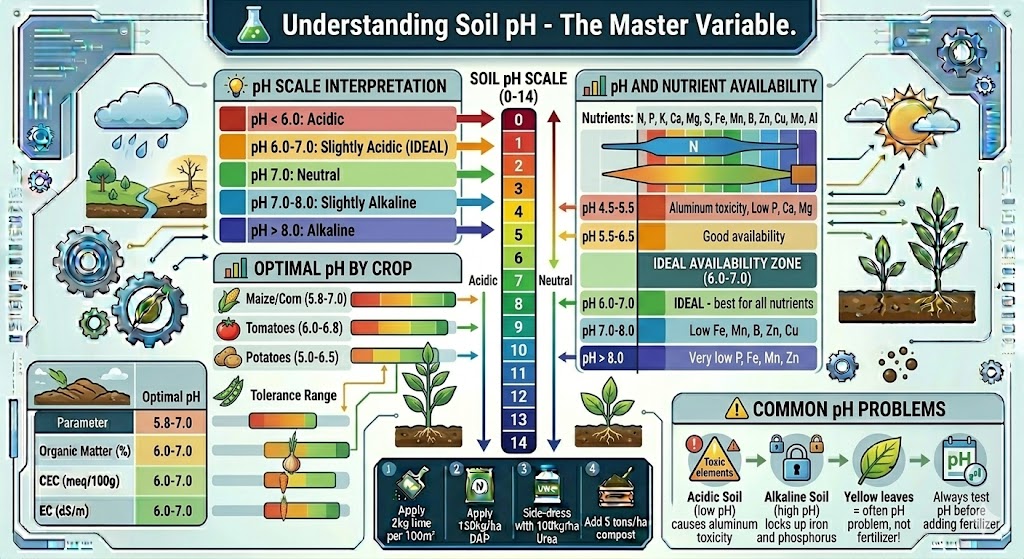
Understanding Soil pH - The Master Variable
🧪 Understanding Soil pH - The Master Variable
🌱 What You'll Learn in This Lesson:
- 🧪 Understand what soil pH means and why it matters
- 📊 Learn optimal pH ranges for 15+ common African crops
- 🔬 Discover how pH affects nutrient availability
- 🛠️ Learn practical methods to adjust soil pH
- 💰 Save money by testing pH before buying fertilizer
Soil pH measures acidity or alkalinity on a scale of 0-14. It's the most important factor affecting nutrient availability. A pH problem can make fertilizer completely useless!
🌟 pH Scale Interpretation:
- pH < 6.0: Acidic soil (common in high rainfall areas like Western Kenya, Uganda)
- pH 6.0-7.0: Slightly acidic (IDEAL for most crops)
- pH 7.0: Neutral
- pH 7.0-8.0: Slightly alkaline (common in dry areas like Northern Nigeria, Kenya)
- pH > 8.0: Alkaline soil (nutrient lockout common)
📊 Optimal pH by Crop
| Crop | Optimal pH | Tolerance Range | Best For |
|---|---|---|---|
| 🌽 Maize/Corn | 5.8-7.0 | 5.5-7.5 | Wide adaptation |
| 🍅 Tomatoes | 6.0-6.8 | 5.5-7.5 | Slightly acidic |
| 🥔 Potatoes | 5.0-6.5 | 4.5-7.0 | Acidic tolerant |
| 🌿 Beans | 6.0-7.0 | 5.5-7.5 | Neutral preference |
| 🧅 Onions | 6.0-7.0 | 5.8-7.5 | Near neutral |
| 🥕 Carrots | 6.0-7.0 | 5.5-7.5 | Near neutral |
| 🌶️ Peppers | 6.0-6.8 | 5.5-7.5 | Slightly acidic |
| 🥬 Cabbage | 6.0-7.0 | 5.8-7.5 | Near neutral |
| 🍆 Eggplant | 5.8-6.8 | 5.5-7.5 | Slightly acidic |
| 🌾 Wheat | 6.0-7.5 | 5.5-8.0 | Wide tolerance |
| 🥜 Groundnuts | 5.8-6.5 | 5.5-7.0 | Prefers acidic |
| 🍓 Strawberries | 5.5-6.5 | 5.0-7.0 | Acidic loving |
| 🌿 Cassava | 5.5-6.5 | 5.0-7.5 | Acidic tolerant |
| 🌱 Coffee | 5.5-6.5 | 5.0-7.0 | Acidic loving |
| 🍵 Tea | 4.5-5.5 | 4.0-6.0 | Very acidic |
📊 pH and Nutrient Availability
═══════════════════════════════════════════════════════════════════════════════
                    NUTRIENT AVAILABILITY BY pH
═══════════════════════════════════════════════════════════════════════════════

  pH Range     |  Limiting Nutrients           |  Problems
  ═════════════╪═══════════════════════════════╪═════════════════════════════════
  4.5-5.5      |  Low P, Ca, Mg               |  Aluminum toxicity common
               |  Low Mo                       |  Poor root growth
  ═════════════╪═══════════════════════════════╪═════════════════════════════════
  5.5-6.5      |  Moderate availability       |  Good for potatoes
               |  Slightly low P              |  Add phosphorus
  ═════════════╪═══════════════════════════════╪═════════════════════════════════
  6.0-7.0      |  IDEAL for ALL nutrients!    |  Best for most crops
               |  Maximum availability        |  No adjustments needed
  ═════════════╪═══════════════════════════════╪═════════════════════════════════
  7.0-8.0      |  Low Fe, Mn, B, Zn, Cu       |  Yellow leaves (iron deficiency)
               |  Low P                       |  Poor flowering
  ═════════════╪═══════════════════════════════╪═════════════════════════════════
  > 8.0        |  Very low P, Fe, Mn, Zn      |  Severe nutrient lockout
               |  Sodium toxicity possible    |  Poor crop growth

═══════════════════════════════════════════════════════════════════════════════
🔬 Key Takeaway:
Most nutrients are available at pH 6.0-7.0. Outside this range, plants cannot access nutrients even if they're present in the soil. Testing pH before buying fertilizer saves money!
⚠️ Common pH Problems & Solutions:
- Acidic soil (low pH): Aluminum toxicity, yellow leaves → Add agricultural lime
- Alkaline soil (high pH): Iron deficiency (yellow leaves with green veins) → Add sulfur or organic matter
- Yellow leaves = often pH problem, not fertilizer! Test pH before adding expensive fertilizers
- Always test pH before planting - save money by fixing pH first
🛠️ How to Adjust Soil pH
| Condition | Cause | Solution | Application Rate |
|---|---|---|---|
| Too Acidic (pH < 5.5) | High rainfall, excessive fertilizer | Agricultural lime (calcium carbonate) | 1-3 tons per hectare |
| Slightly Acidic (pH 5.5-6.0) | Normal for humid regions | Dolomitic lime (adds magnesium) | 0.5-1 ton per hectare |
| Too Alkaline (pH > 7.5) | Dry climate, irrigation with hard water | Elemental sulfur or organic matter | 0.5-1 ton sulfur per hectare |
| Slightly Alkaline (pH 7.0-7.5) | Low rainfall areas | Compost, manure, sulfur (slow) | 10-20 tons compost/hectare |
💡 Pro Tips for pH Management:
- 📍 Test every 2-3 years - pH changes slowly, but monitoring prevents problems
- 📍 Apply lime 2-3 months before planting - takes time to react with soil
- 📍 Use dolomitic lime if magnesium is low - adds both Ca and Mg
- 📍 Incorporate lime into top 15cm of soil - not just surface application
- 📍 Retest after 6 months - verify pH changed as expected
🎉 Congratulations!
- ✅ Understand what soil pH means and why it's critical for crop growth
- ✅ Know optimal pH ranges for 15+ common African crops
- ✅ Identify nutrient deficiency symptoms caused by wrong pH
- ✅ Calculate lime or sulfur requirements to adjust pH
- ✅ Save money by testing pH before buying fertilizer
| pH Range | Interpretation | Recommended Action |
|---|---|---|
| < 5.0 | Very Acidic | Apply 2-3 tons lime/hectare |
| 5.0-5.5 | Acidic | Apply 1-2 tons lime/hectare |
| 5.5-6.0 | Slightly Acidic | Apply 0.5-1 ton lime/hectare |
| 6.0-7.0 | IDEAL | No adjustment needed |
| 7.0-7.5 | Slightly Alkaline | Add organic matter, compost |
| 7.5-8.0 | Alkaline | Apply 0.5-1 ton sulfur/hectare |
| > 8.0 | Very Alkaline | Apply 1-2 tons sulfur/hectare |
💡 Key Takeaways:
- Apply these concepts directly to your farm or project.
- Take notes on important details for the quiz.
- Use the button below to track your progress.
×
![Enlarged view]()