← Back to Course
Understanding NPK - Essential Plant Nutrients
🧪 Understanding NPK - The Three Essential Nutrients for Crop Growth
🌱 What You'll Learn in This Lesson:
- 🌿 Understand Nitrogen (N), Phosphorus (P), and Potassium (K) roles in plant growth
- 📊 Learn optimal NPK ranges for 12+ common African crops
- 🏷️ Decode fertilizer labels like "10-20-10"
- 🛠️ Calculate exactly how much fertilizer to apply
- 💰 Save money by applying only what your soil needs
NPK stands for Nitrogen (N), Phosphorus (P), and Potassium (K) - the three primary macronutrients essential for plant growth. Understanding these nutrients is the foundation of successful farming.
🌟 What Each Nutrient Does:
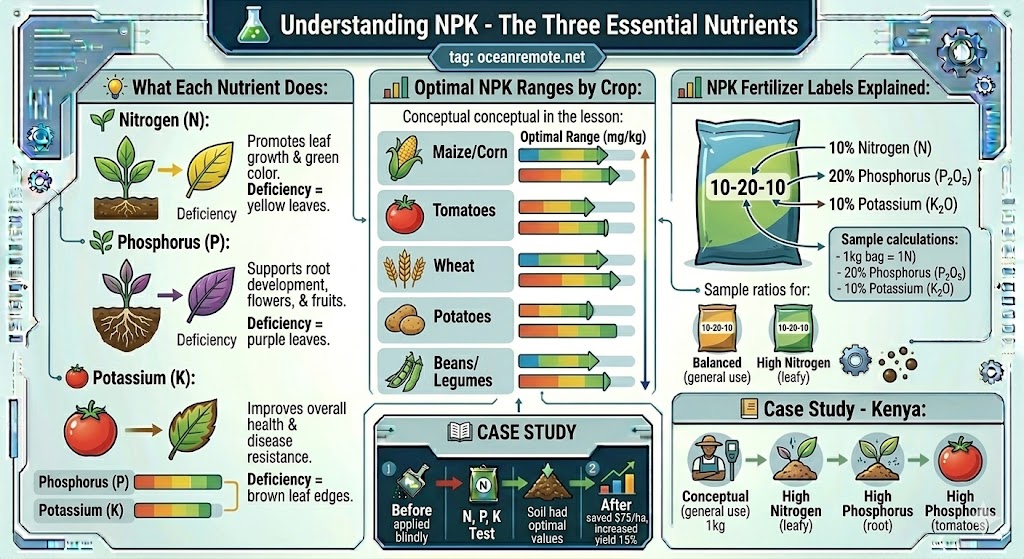
- 🌱 Nitrogen (N): Promotes leaf growth and green color. Deficiency = yellow lower leaves, stunted growth.
- 🌿 Phosphorus (P): Supports root development, flowers, and fruits. Deficiency = purple leaves, poor roots.
- 🍅 Potassium (K): Improves overall health, disease resistance, and fruit quality. Deficiency = brown leaf edges, weak stems.
📊 Optimal NPK Ranges by Crop
| Crop | Nitrogen (N) mg/kg | Phosphorus (P) mg/kg | Potassium (K) mg/kg | Notes |
|---|---|---|---|---|
| 🌽 Maize/Corn | 150-200 | 30-50 | 150-250 | High N for leaf growth |
| 🍅 Tomatoes | 180-250 | 40-60 | 200-300 | Needs extra K for fruit |
| 🌾 Wheat | 120-180 | 25-40 | 120-200 | Moderate requirements |
| 🥔 Potatoes | 140-200 | 35-55 | 180-280 | High K for tuber quality |
| 🌿 Beans/Legumes | 80-120 | 25-40 | 100-180 | Fix own nitrogen |
| 🌶️ Peppers | 160-220 | 35-55 | 180-280 | Similar to tomatoes |
| 🧅 Onions | 100-150 | 25-40 | 120-200 | Moderate all around |
| 🥕 Carrots | 80-120 | 30-50 | 150-250 | Low N, high K |
| 🍆 Eggplant | 150-200 | 35-55 | 180-280 | Fruiting crop needs more |
| 🥜 Groundnuts | 70-110 | 20-35 | 80-150 | Low N (fix own) |
| 🍓 Strawberries | 100-150 | 30-50 | 150-250 | Needs P for fruit set |
| 🌿 Cassava | 60-100 | 20-30 | 80-150 | Tolerant of low fertility |
📊 NPK Fertilizer Labels Explained
═══════════════════════════════════════════════════════════════════════════════
                    FERTILIZER LABEL INTERPRETATION
═══════════════════════════════════════════════════════════════════════════════

  Fertilizer label "10-20-10" means:
  ┌─────────────────────────────────────────────────────────────────────────┐
  │  10% Nitrogen (N)                                                       │
  │  20% Phosphorus (P₂O₅)                                                  │
  │  10% Potassium (K₂O)                                                    │
  └─────────────────────────────────────────────────────────────────────────┘

  Example calculations for 1kg (1000g) bag:
  • Nitrogen: 100g
  • Phosphorus: 200g
  • Potassium: 100g

═══════════════════════════════════════════════════════════════════════════════
                    COMMON FERTILIZER TYPES
═══════════════════════════════════════════════════════════════════════════════

  Label      |  N-P-K   |  Best For
  ═══════════╪══════════╪══════════════════════════════════════════════════════
  10-10-10   |  Balanced  |  General use, soil building
  20-10-10   |  High N    |  Leafy vegetables, maize, grass
  5-20-20    |  High P    |  Root crops, flowers, seedlings
  15-30-15   |  High P    |  Tomatoes, peppers, fruiting vegetables
  0-20-20    |  No N      |  Legumes (beans, peas) - they fix their own N
  0-0-60     |  Potash    |  Potassium only - for fruit quality
  Urea (46-0-0) | Pure N |  Quick nitrogen boost (use carefully!)
  DAP (18-46-0) | High N & P |  Planting fertilizer for maize

═══════════════════════════════════════════════════════════════════════════════
📐 How to Calculate Fertilizer Application:
Formula: Fertilizer needed = (Nutrient required ÷ % nutrient in fertilizer) × 100
Example: Need 30kg Nitrogen using Urea (46% N)
= (30 ÷ 46) × 100 = 65kg Urea per hectare
📊 Recognizing NPK Deficiencies
| Nutrient | Deficiency Symptoms | Common Causes | Quick Fix |
|---|---|---|---|
| Nitrogen (N) | Yellow lower leaves, stunted growth, thin stems | Sandy soil, heavy rain leaching, low organic matter | Apply urea, manure, or compost |
| Phosphorus (P) | Purple/reddish leaves, poor root growth, delayed maturity | Cold soil, acidic soil (pH < 5.5), low organic matter | Apply DAP, TSP, or bone meal |
| Potassium (K) | Brown leaf edges (scorching), weak stems, poor fruit quality | Sandy soil, excessive rainfall, high crop removal | Apply MOP (potash), wood ash, or compost |
📖 Case Study - NPK Sensor Saves Kenyan Farmer $75/Hectare:
A maize farmer in Nakuru, Kenya used NPK sensors to optimize fertilizer application:
- Before: Applied 200kg/ha of 10-10-10 fertilizer blindly = $150/ha
- NPK Test Results: N:180, P:45, K:220 (already optimal for maize!)
- After: Reduced fertilizer by 50% → saved $75/ha
- Result: Yield increased 15% from not over-fertilizing
"The NPK sensor paid for itself in the first season. Now I only buy the fertilizer my soil actually needs." - Farmer, Nakuru, Kenya
⚠️ Common NPK Mistakes to Avoid:
- Over-fertilizing: Wastes money, damages soil, causes environmental pollution
- Ignoring soil tests: You might need only 1 nutrient, not all 3!
- Applying at wrong time: Split applications (2-3 times) are better than one big dose
- Forgetting legumes: Beans/peas fix their own nitrogen - don't add extra N!
- pH problems: If pH is wrong, fertilizer won't work regardless of how much you apply
💡 Best Practices for NPK Management:
- 📍 Test NPK every 1-2 years - don't guess, measure!
- 📍 Use split applications - apply 50% at planting, 50% at mid-season for maize
- 📍 Incorporate into soil - surface application loses nitrogen to air
- 📍 Combine with organic matter - compost and manure boost soil health
- 📍 Consider slow-release fertilizers - less leaching, more efficient
🎉 Congratulations!
- ✅ Understand the roles of Nitrogen, Phosphorus, and Potassium in plant growth
- ✅ Know optimal NPK ranges for 12+ common African crops
- ✅ Decode fertilizer labels like "10-20-10"
- ✅ Recognize NPK deficiency symptoms in your crops
- ✅ Calculate exactly how much fertilizer to apply
- ✅ Save money by applying only what your soil needs
| Nutrient | Symbol | Primary Function | Deficiency Sign | Best Source |
|---|---|---|---|---|
| Nitrogen | N | Leaf growth | Yellow lower leaves | Urea, manure, compost |
| Phosphorus | P | Roots & flowers | Purple leaves | DAP, bone meal, TSP |
| Potassium | K | Health & fruit | Brown leaf edges | MOP, wood ash, compost |
💡 Key Takeaways:
- Apply these concepts directly to your farm or project.
- Take notes on important details for the quiz.
- Use the button below to track your progress.
×
![Enlarged view]()