Irrigation Basics - Part 1
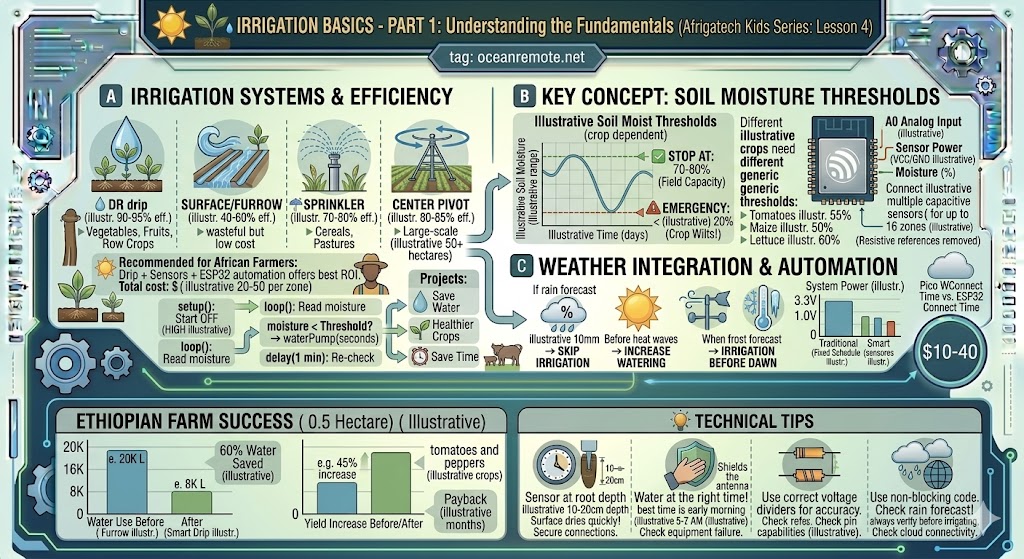
💧 Irrigation Basics - Part 1: Understanding the Fundamentals
💧 What You'll Learn:
- 🌾 Understand different irrigation methods and when to use each
- 💧 Learn how smart irrigation saves 30-40% water
- 📊 Discover soil moisture thresholds for optimal watering
- 💰 Calculate ROI of switching to smart irrigation
Irrigation is the artificial application of water to soil for growing crops. In Africa, where water scarcity affects millions of farmers, efficient irrigation is critical. Smart irrigation uses sensors and automation to water crops only when they need it, saving water and improving yields.
📊 Types of Irrigation Systems
- 💧 Drip Irrigation (90-95% efficient): Water drips directly to plant roots. Best for vegetables, fruits, row crops.
- 🌊 Surface/Furrow (40-60% efficient): Water flows through furrows between rows. Low cost but wasteful.
- ☔ Sprinkler (70-80% efficient): Water sprayed like rain. Good for cereals and pastures.
- 🌀 Center Pivot (80-85% efficient): Large-scale rotating sprinkler. For commercial farms 50+ hectares.
Drip irrigation + soil moisture sensors + ESP32 automation offers the best ROI. Drip saves 90%+ water efficiency, sensors tell you when to water, and ESP32 automates the process. Total cost: $20-50 per zone.
🔧 Key Concepts of Smart Irrigation
📊 1. Soil Moisture Thresholds
- Water when: Soil moisture drops below 30-40% (crop dependent)
- Stop when: Moisture reaches 70-80% (field capacity)
- Emergency: If moisture below 20%, water immediately or crop wilts!
- Different crops need different thresholds: Tomatoes 55%, Maize 50%, Lettuce 60%
🌧️ 2. Weather Integration
- Skip irrigation: When rain forecast > 10mm (save water and money)
- Increase watering: Before heat waves (prevents crop stress)
- Delay watering: When high winds predicted (evaporation loss)
- Frost protection: Irrigate before dawn when frost forecast
⚡ 3. Automated Valves (Relays)
- ESP32 sends signal → Relay switches → Pump turns ON/OFF
- Automatically turns water ON when soil is dry (below threshold)
- Automatically turns water OFF when soil is moist (above threshold)
- Can control multiple zones (1-16 zones with one ESP32)
A smallholder farmer switched from furrow to smart drip irrigation on 0.5 hectares:
- 💧 Before: Furrow irrigation, 20,000 liters/day, low yields
- 💧 After: Smart drip, 8,000 liters/day, 60% water saved
- 📈 Yield increase: 45% (tomatoes and peppers)
- 💰 System cost: $150 for drip tape + $30 for ESP32/sensor/relay
- ⏰ Payback period: 2 months from water savings alone
"Smart irrigation changed my life. I save money, time, and my crops are healthier than ever." - Farmer, Ethiopia
📊 Benefits of Smart Irrigation
- 💧 Save 30-50% on water bills - Water only when needed, not on schedule
- 🌱 Healthier crops - No over-watering (root rot) or under-watering (stress)
- ⏰ Save 10+ hours/week - No manual watering; system runs automatically
- 📈 Increase yields by 20-40% - Optimal moisture at all growth stages
- 🔋 Lower energy costs - Pumps run 50% less frequently
- 🌍 Environmental benefits - Reduced runoff, less fertilizer leaching
- 📱 Remote monitoring - Check soil moisture from anywhere
- System cost: ESP32 ($8) + 4 sensors ($40) + 4 relays ($20) + drip tape ($150) = $218
- Annual water savings: 2,000,000 liters saved × $0.001 per liter = $2,000 saved
- Yield increase: 30% × $3,000 revenue = $900 additional profit
- Total annual benefit: $2,900
- Payback period: Less than 1 month!
- ❌ Sensor too shallow: Place at root depth (10-20cm), not surface (surface dries quickly)
- ❌ Ignoring rain forecast: Always check before irrigating - water is expensive!
- ❌ Not calibrating sensors: Every sensor is different - calibrate yours!
- ❌ Watering at wrong time: Best time is early morning (5-7 AM) or evening (6-8 PM)
- ❌ Using resistive sensors: They corrode in months. Buy capacitive sensors (last years)
- ✅ Drip irrigation = most efficient (90-95%) for vegetables
- ✅ Smart irrigation saves 30-50% water + increases yields 20-40%
- ✅ Soil moisture threshold: Water below 30-40%, stop at 70-80%
- ✅ Always check rain forecast before irrigating
- ✅ ROI payback period is often 1-2 months
- ✅ Capacitive sensors last years; resistive sensors fail in months
Next lesson: Irrigation Basics - Part 2: Drip System Design and Installation
- Apply these concepts directly to your farm or project.
- Take notes on important details for the quiz.
- Use the button below to track your progress.