Why Track Rainfall?
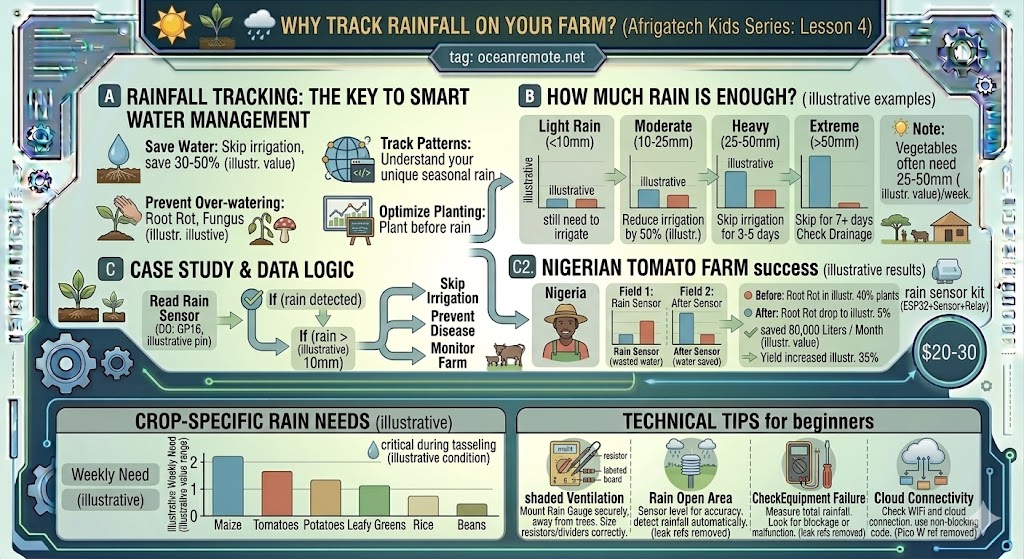
🌧️ Why Track Rainfall on Your Farm - The Key to Smart Water Management
🌧️ What You'll Learn:
- 📊 Understand why rainfall tracking is essential for farm success
- 💧 Learn how much rain is enough for different crops
- 💰 Save water and money by irrigating only when needed
- 🌾 Prevent over-watering diseases like root rot
Rainfall is one of the most important weather parameters for farming. Knowing exactly how much rain falls on your fields helps you make better irrigation decisions - saving water, preventing disease, and increasing yields. A simple $3 rain sensor can save thousands of liters of water annually.
📊 Benefits of Rain Monitoring
- 💧 Save Water: Skip irrigation when enough rain has fallen (30-50% water savings)
- 🌱 Prevent Over-watering: Too much water causes root rot, fungal diseases, and nutrient leaching
- 📈 Track Seasonal Patterns: Understand your farm's unique rainfall patterns over years
- 🌾 Optimize Planting: Plant before expected rains for better germination and less irrigation
- 💰 Reduce Costs: Lower water bills, less fertilizer runoff, healthier crops
A farmer who irrigates on a fixed schedule wastes 30-50% of water when it rains. On a 1-hectare farm, that's 4,000-8,000 liters wasted per rain event! Over a rainy season, that's $100-200 in unnecessary water costs plus flooded, diseased crops.
🧮 How Much Rain Is Enough?
- Most vegetables: Need 25-50mm (1-2 inches) of water per week
- Light rain (< 10mm / 0.4 inches): Still need to irrigate - only wet surface
- Moderate rain (10-25mm / 0.4-1 inch): Reduce irrigation by 50%
- Heavy rain (25-50mm / 1-2 inches): Skip irrigation for 3-5 days
- Extreme rain (> 50mm / 2 inches): Skip irrigation for 7+ days, check drainage
A tomato farmer installed a rain sensor connected to their irrigation controller:
- 💧 Before: Irrigated 2 hours daily regardless of rain
- 🌧️ Rainy season: 4 rain events per week (15mm each on average)
- 💡 Problem: Over-watering caused root rot in 40% of plants
- ✅ Fix: Rain sensor disabled irrigation when rain detected
- 📈 Result: Root rot dropped to 5%, water saved = 80,000 liters/month, yield increased 35%
"The $3 rain sensor saved my entire tomato crop and paid for itself in the first rain!" - Farmer, Nigeria
🌾 Crop-Specific Rainfall Needs
- 🌽 Maize (Corn): 25-38mm per week (critical during tasseling)
- 🍅 Tomatoes: 25-50mm per week (keep consistent to prevent blossom end rot)
- 🥔 Potatoes: 25-38mm per week (avoid over-watering 2 weeks before harvest)
- 🥬 Leafy greens: 25-38mm per week (shallow roots need frequent light rain)
- 🌾 Rice (paddy): 50-100mm per week (needs standing water)
- 🌿 Beans: 18-25mm per week (drought tolerant, avoid wet leaves)
Even after heavy rain, soil moisture might still be low if rain ran off rather than soaking in. Always verify with a soil moisture sensor before skipping irrigation. Compacted soil, slopes, and dry soil can cause runoff even during heavy rain.
📊 Seasonal Rainfall Patterns in Africa
- West Africa (Nigeria, Ghana): April-October rainy season, 1,200-2,000mm/year
- East Africa (Kenya, Tanzania): March-May & October-December rainy seasons, 500-1,500mm/year
- Southern Africa (Zambia, Zimbabwe): November-March rainy season, 600-1,000mm/year
- North Africa (Egypt, Morocco): November-March light rain, 50-400mm/year (irrigation critical)
- 🌧️ Standing water in fields for > 24 hours
- 🍂 Yellowing lower leaves (soggy roots)
- 🦠 Fungus or mold on leaves or fruit
- 🥔 For potatoes: rot during storage
- ⚠️ Action: Stop irrigation immediately, improve drainage, apply fungicide if needed
- ✅ Most vegetables need 25-50mm (1-2 inches) of rain per week
- ✅ Light rain (<10mm) does NOT replace irrigation
- ✅ Heavy rain (>25mm) = skip irrigation for 3-5 days
- ✅ A $3 rain sensor pays for itself within weeks of installation
- ✅ Always combine rain data with soil moisture for best decisions
- ✅ Over-watering causes root rot, disease, and nutrient leaching
Next lesson: Connecting a Rain Sensor to Your ESP32
- Apply these concepts directly to your farm or project.
- Take notes on important details for the quiz.
- Use the button below to track your progress.