Beyond Moisture: pH and Nutrients
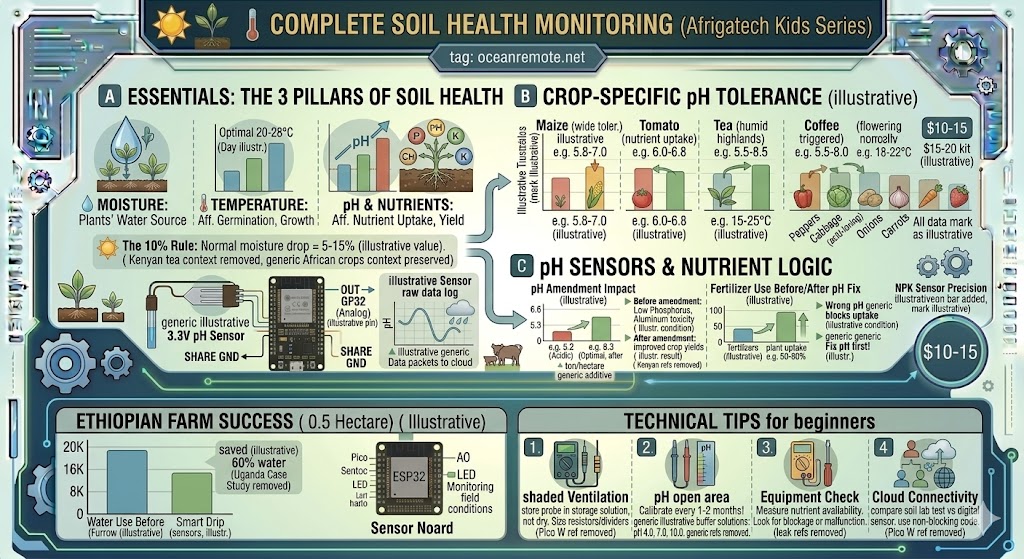
🌱 Complete Soil Health Monitoring - Beyond Moisture and Temperature
🌱 What You'll Learn:
- 📊 Understand why pH and nutrient levels matter for crop health
- 🌾 Learn optimal pH ranges for maize, tomatoes, beans, potatoes, and onions
- 🧪 Connect pH sensors to ESP32 for automated soil monitoring
- 🛠️ Fix pH issues with lime, wood ash, or sulfur
While moisture and temperature are critical, soil health also depends on pH and nutrient levels. A soil with perfect moisture but wrong pH will still have poor yields because plants cannot access nutrients. Healthy soil = optimal pH + balanced nutrients + good moisture.
📊 What is Soil pH and Why Does It Matter?
- pH scale: 0-14 (acidic → neutral → alkaline)
- Optimal range for most crops: 6.0-7.0 (slightly acidic to neutral)
- pH below 5.5: Aluminum toxicity, low phosphorus, poor root growth
- pH above 7.5: Iron deficiency, yellow leaves, poor fruit set
- At wrong pH, fertilizer becomes unavailable - your money is wasted!
You can apply perfect fertilizer, but if pH is wrong, plants can't access 50-80% of those nutrients. A $100 fertilizer investment becomes $20-50 of actual benefit. Fix pH first, then fertilize!
📊 Optimal Soil pH by Crop
- 🌽 Maize (Corn): 5.8-7.0 (wide tolerance, best at 6.2-6.8)
- 🍅 Tomatoes: 6.0-6.8 (slightly acidic for nutrient uptake)
- 🌿 Beans: 6.0-7.0 (neutral preferred, fix their own nitrogen)
- 🥔 Potatoes: 5.0-6.5 (acid-loving, scab disease if too alkaline)
- 🧅 Onions: 6.0-7.0 (neutral, sensitive to acidic soil)
- 🌶️ Peppers: 6.0-6.8 (similar to tomatoes)
- 🥬 Cabbage: 6.5-7.0 (slightly alkaline preferred)
- 🥕 Carrots: 6.0-7.0 (neutral, fork roots if too acidic)
- 🍆 Eggplant: 5.5-6.8 (slightly acidic to neutral)
- 🍓 Strawberries: 5.5-6.5 (acid-loving)
🧪 Adding pH Sensors to Your ESP32
pH sensors connect similarly to moisture sensors but require calibration. Most agricultural pH sensors cost $10-20 and connect to ESP32 analog pins.
- pH Sensor VCC → 3.3V or 5V (check sensor specs)
- pH Sensor GND → GND
- pH Sensor OUT → GPIO32 or GPIO33 (analog pin)
- Calibration needed: Use pH 4.0, 7.0, and 10.0 buffer solutions
- Read pH:
int phRaw = analogRead(PH_PIN); float ph = map(phRaw, 0, 4095, 0, 14);
- pH sensors are NOT plug-and-play - they MUST be calibrated
- Use buffer solutions: pH 4.0, 7.0, and 10.0
- Calibrate every 1-2 months for accuracy
- Store probe in storage solution (not dry)
- Cheap sensors ($10) work but need frequent calibration
- Too acidic (low pH < 5.5): Add lime (calcium carbonate) or wood ash. Apply 1-2 tons per hectare for every 0.5 pH increase needed.
- Too alkaline (high pH > 7.5): Add elemental sulfur, organic matter (compost), or pine needles. Apply 0.5-1 ton sulfur per hectare.
- When to apply lime: 2-3 months before planting (takes time to react)
- Test every 3 months: pH changes slowly, but monitoring prevents problems
- Retest after amendments: Verify pH changed as expected before planting
A soybean farmer was getting poor yields despite good fertilizer. A pH test revealed 5.2 (too acidic):
- 🌱 Problem: Soybeans need pH 6.0-7.0, soil was 5.2
- 🔬 Fix: Applied 2 tons of lime per hectare, waited 3 months
- 📊 Result pH: Increased to 6.3
- 📈 Yield: Increased from 0.8 to 1.8 tons per hectare (125% increase)
- 💰 ROI: $50 lime investment returned $400 in extra yield
"I wasted fertilizer for 3 seasons because I didn't know my pH was wrong. Now I test every season." - Soybean Farmer, Zambia
📊 NPK Nutrients - The Fertilizer Connection
- Nitrogen (N): Leaf growth, green color. Low N = yellow lower leaves
- Phosphorus (P): Root development, flowers. Low P = purple leaves
- Potassium (K): Fruit quality, disease resistance. Low K = brown leaf edges
- NPK sensors ($50-200): Advanced option for precision farming
- Without NPK sensor: Use soil lab testing ($20-30 per sample)
- ✅ Optimal pH for most crops: 6.0-7.0
- ✅ Wrong pH blocks 50-80% of fertilizer availability
- ✅ Fix pH first, then fertilize - saves money and improves yields
- ✅ Acidic soil (< 5.5): Add lime or wood ash
- ✅ Alkaline soil (> 7.5): Add sulfur or organic matter
- ✅ Test pH every 3 months using manual kit ($15) or digital sensor ($20)
Next lesson: Integrating Multiple Sensors - Complete Soil Monitoring Station
- Apply these concepts directly to your farm or project.
- Take notes on important details for the quiz.
- Use the button below to track your progress.