IoT in Everyday Life
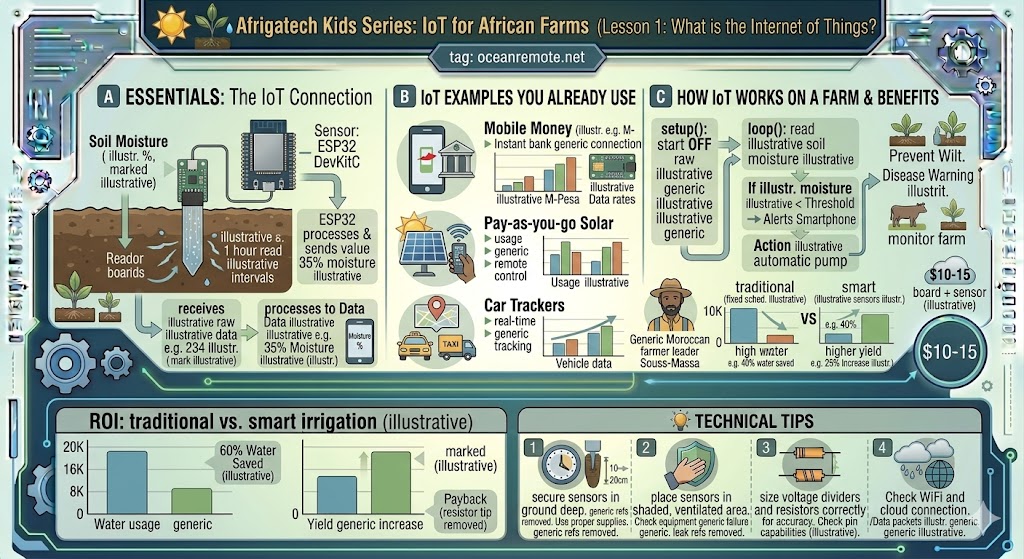
🌐 What is the Internet of Things? - Connecting Your Farm to the Cloud
🌐 What You'll Learn:
- 📱 Understand what IoT means and how it applies to your farm
- 💡 See IoT examples you already use (M-Pesa, pay-as-you-go solar, car trackers)
- 🚜 Learn how soil sensors, water pumps, and weather stations connect to your phone
- 💧 Discover how IoT can save up to 40% of water on your farm
The Internet of Things (IoT) is a simple but powerful idea: take regular objects and connect them to the internet. Your smartphone is already connected. Now imagine your soil moisture sensor, water pump, and weather station all talking to each other - and to you!
📱 IoT Examples You Already Use in Africa
- 💰 Mobile Money (M-Pesa, Orange Money, MTN Mobile Money): Your phone talks to bank servers instantly to send and receive money. That's IoT - a device (your phone) connected to the internet to provide a service.
- ☀️ Pay-as-you-go Solar (SunCulture, d.light, Azuri): Solar companies track your usage remotely and can turn systems on/off. They know if your panel is producing power and if your battery is charged - without visiting your farm.
- 🚗 Car Trackers: Taxi and delivery owners track vehicles online in real-time. They know where their cars are, how fast they're going, and when they need maintenance.
- 📊 Smart Meters: Electricity and water meters that report usage automatically. The utility company never needs to send someone to read your meter.
- 📡 Satellite TV (DSTV, StarTimes, Zuku): Your decoder connects to the internet to show you what's on, stream content, and manage your subscription.
If you use M-Pesa, check WhatsApp, watch Netflix, or have pay-as-you-go solar - you're already using IoT. The same technology can now work for your farm. Soil moisture sensors, weather stations, and automated irrigation are just the next step.
🚜 How IoT Works on a Farm - Step by Step
📡 IoT Farm Data Flow:
🌱 Soil Sensor → 🖥️ ESP32 → 📡 WiFi/GSM → ☁️ Cloud → 📱 Your Phone
- 🌱 Step 1 - Sense: A soil moisture sensor is placed in the ground at root depth (10-20cm). It reads the water level every hour.
- 🖥️ Step 2 - Process: The sensor sends data to a small computer (ESP32 or ESP8266) which converts raw readings into a percentage - "28% moisture".
- 📡 Step 3 - Transmit: The ESP32 sends the data through WiFi (or GSM for remote areas) to the internet.
- ☁️ Step 4 - Store: OceanRemote cloud servers save your data securely for historical tracking.
- 📱 Step 5 - View: You open the OceanRemote app or website on your phone. You see: "Soil: 28% moisture".
- 🚨 Step 6 - Alert: When moisture drops below 30%, you get an automatic alert: "⚠️ Time to water your crops!"
- 💧 Step 7 - Act (Optional): Your ESP32 can automatically turn on the water pump via relay - no manual action needed!
Farmers in the Souss-Massa region use soil sensors connected to their phones:
- 💧 Problem: Farmers watered on fixed schedules, wasting up to 40% of water
- 🔧 Solution: Soil moisture sensors send data to phones every hour
- 📱 Result: Farmers water only when soil moisture drops below threshold
- 💧 Water saved: 30-40% reduction = thousands of liters saved monthly
- 📈 Yield increase: 20-35% better harvests from optimal watering
"Our phones tell us exactly when to water. No more guessing. No more waste." - Farmer, Souss-Massa, Morocco
💧 Real Impact: Water Savings with IoT
- 🚜 Traditional farming: Water on fixed schedule → 30-50% water wasted
- 💡 Smart IoT farming: Water only when needed → save 30-40% water
- 💰 Cost savings: $50-200/month less on water bills (depends on farm size)
- 🌍 Environmental impact: Less runoff, less fertilizer leaching, healthier soil
- 📋 Traditional: Water every day at 6 AM (whether needed or not)
- 🤷 Problem: Wastes water when raining, under-waters during heat waves
- 💡 IoT Way: Check soil moisture first → water only if below 30%
- ✅ Result: Perfect watering every time, rain or shine, hot or cool
- 📡 Yes, but minimal: IoT works on 2G, 3G, 4G - even slow connections work
- 📦 Very small data: Each reading is only 50-200 bytes (smaller than a text message)
- 💾 Offline storage: ESP32 stores data if internet goes down, sends when connection returns
- 🏞️ No internet at all? Consider GSM module (SIM800L) for cellular connection ($10-15)
- ✅ IoT = connecting everyday objects to the internet (like M-Pesa, smart meters)
- ✅ On a farm: soil sensors + ESP32 + internet + your phone = smart irrigation
- ✅ IoT can save 30-40% of water by watering only when needed
- ✅ You already use IoT (mobile money, solar trackers) - farm sensors are the next step
- ✅ Even slow 2G internet works for IoT (data packets are tiny)
- ✅ IoT gives you real-time information and automatic alerts - no more guessing
Next lesson: How IoT Helps Farmers - Real Benefits and Case Studies
- Apply these concepts directly to your farm or project.
- Take notes on important details for the quiz.
- Use the button below to track your progress.